

Managing corporate devices (or endpoints) is essential to guarantee the security of the data accessed through them. To enable modern management that leverages Agentic AI, it is critical to have complete visibility: accurate, real-time information on the status of every terminal with access to corporate data. In this new paradigm, Unified Endpoint Management platforms like Applivery become indispensable, acting as the master data bridge that enables total, real-time supervision.
Laptops, smartphones, tablets, and any device with access to organizational information are part of an attack surface that must be controlled, monitored, and maintained at all times. But control isn’t just knowing a device exists: it’s knowing its real, verified status at any given second. This difference, between merely inventorying and truly knowing,is what separates a reactive security posture from a truly operational one.
Without this layer of reliable and updated knowledge, any automation process, and specifically any AI agent operates on a reality it cannot verify. And an agent that cannot verify its context is not an intelligent agent: it is a dangerous one.
unlimited trial of Applivery
Why manual device management no longer scales?
Modern organizations face a structural challenge with their endpoint fleets. The number of devices has grown in volume, diversity, and geographic dispersion at a speed that far exceeds any IT team’s capacity for manual management. Four factors turn this challenge into a strategic urgency:
-
Unmanageable volume: the sheer number of corporate devices makes manual management impossible. Every onboarding, offboarding, or configuration change consumes resources that do not scale with the organization’s growth.
-
Fleet heterogeneity: the diversity of operating systems, manufacturers, and versions complicates security management. Applying consistent policies across a heterogeneous fleet requires automation, not case-by-case manual intervention.
-
Geographic dispersion: devices connect to sensitive data from any location (office, remote work, traveling), which complicates information protection and multiplies exposure vectors.
-
Expanding attack surface: the volume, diversity, and location of devices have significantly increased the attack surface, exposing critical information to increasingly sophisticated threats.
These four factors are not independent; they reinforce each other. A single outdated endpoint, in the hands of a remote employee with access to corporate data and without active monitoring, can be the link that compromises the entire security chain. Multiplied by hundreds or thousands of devices, risk becomes statistically inevitable without automation.
UEM as the nervous system and field of action for AI agents
To understand the role of UEM in an Agentic AI architecture, it is helpful to think of two distinct but inseparable functions: UEM as the agent’s nervous system and UEM as its field of action.
UEM as the nervous system
UEM provides the context that AI agents need to make decisions. Just as the nervous system gathers signals from the environment and transmits them to the brain for evaluation, UEM collects signals from every endpoint: compliance status, software version, user behavior, security alerts and makes them available to the agent in real time. The agent evaluates these signals and makes action decisions based on verified data, not assumptions.
UEM as the field of action
UEM is not just a source of information; it is also the space where the agent can intervene. Installing or uninstalling apps, applying or modifying policies, revoking access, quarantining a device, or launching remediation processes. Without UEM, AI agents have nowhere to act. They can reason, recommend, and plan, but their decisions remain theoretical if there is no management layer to execute them on the actual infrastructure.

This dual function makes UEM qualitatively different from just another tool in the tech stack. It is the prerequisite for any AI agent operating on real-world device infrastructure.
Applivery: visibility, control, and actionability over every endpoint
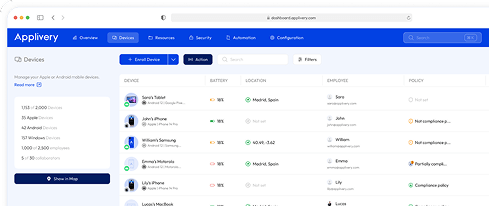
Applivery enables unified management of corporate devices, providing real-time status updates on the entire fleet. We don’t just inventory; our platform provides the capability to act on devices, remediating and restricting when necessary to protect both corporate and employee data.
When a device falls out of compliance or misses a critical update, the platform provides the context and mechanisms to respond. Whether through automation or by empowering the IT team with structured, readily available information, the time between detection and response is reduced from hours to seconds.
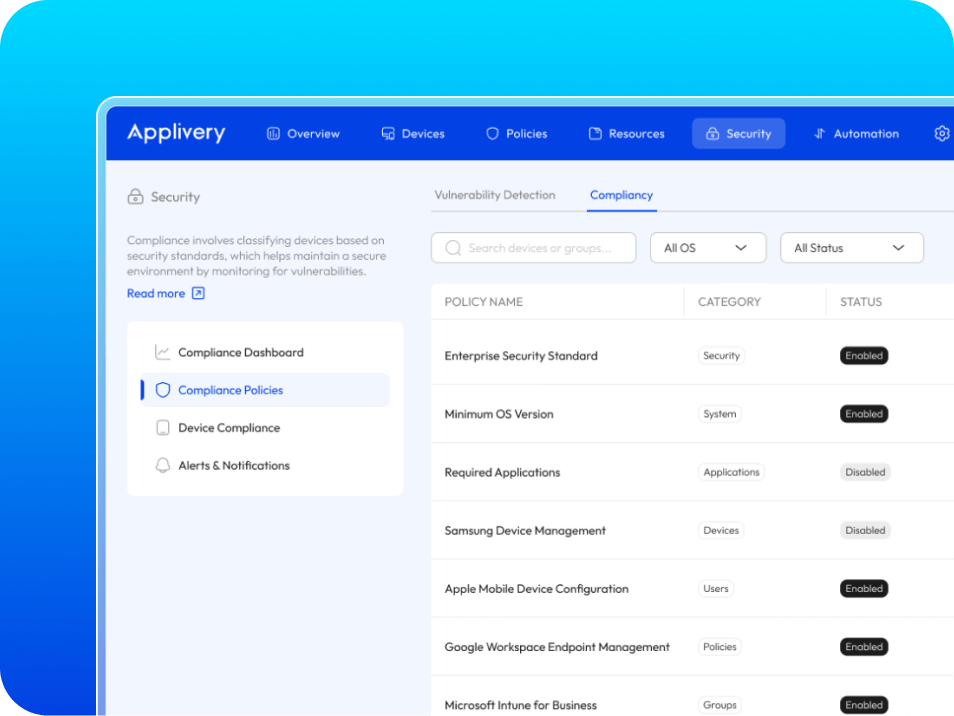
Applivery provides organizations with the data and technology required for AI agents to generate a real impact on security and productivity. Without this reliable master database, AI agents cannot act with judgment: they improvise on incomplete information and take decisions that may seem reasonable but are built on false premises.
Applivery’st three pillars of value
For your AI-powered security strategy to succeed in 2026, you need three elements that Applivery delivers natively:
| Pillar | Technical capability | Impact on AI |
|---|---|---|
|
Visibility |
Total knowledge of hardware, software, and behavior |
Eliminates “blind spots” in decision-making |
|
Control |
Consistent security policies across heterogeneous fleets |
Ensures AI operates under ethical and technical rules |
|
Execution |
Real-time intervention (remediation and restrictions) |
Turns recommendations into real business impact |
A strategic imperative for 2026
UEM is the key piece that allows organizations to implement Artificial Intelligence strategically, effectively, and ethically. Strategically, because without reliable master data, AI agents cannot make informed decisions. Effectively, because without the ability to execute on endpoints, an agent’s decisions are just recommendations without impact. Ethically, because an AI acting on real infrastructure without verified context is not an advancement, it is an unmanaged risk.
Organizations investing in a modern UEM platform like Applivery today are doing more than just improving their security posture. They are building the data and control infrastructure that will make the Autonomous AI of tomorrow possible.
Is your organization ready for Agentic AI?
Discover in a free demo how Applivery provides the master data and actionability that AI agents need to function with judgment and security.
Frequently Asked Questions (FAQ)
What is an AI Agent and why does it need UEM?
An AI Agent is an intelligence capable of executing actions autonomously (such as patching a system or blocking access). To be effective, it needs a Source of Truth regarding device status. Applivery’s UEM acts as this "nervous system," providing the real data and execution channel for the AI to act upon the infrastructure.
How does Applivery prevent AI "hallucinations" in fleet management?
Hallucinations occur when AI makes decisions based on incomplete or outdated data. Applivery ensures the AI works with real-time telemetry. By providing verified information on compliance and health for every endpoint (iOS, Android, Windows, macOS), we ensure automations are based on physical reality, not assumptions.
Is it safe to let AI agents make decisions about my corporate devices?
Security lies in control and policies. With Applivery, you define the operational framework (RBAC and compliance policies) within which the AI can function. Agentic AI doesn't replace security rules; it enforces them at a speed humans cannot match, drastically reducing response times to vulnerabilities.
What is the difference between a traditional inventory and operational visibility for AI?
A traditional inventory is a "snapshot" (what devices I have). The operational visibility Applivery offers is a "live feed" (what is happening right now). In 2026, if an AI agent tries to apply a patch based on yesterday’s inventory, the risk of error is critical. Agentic AI requires live data to be truly "intelligent."
Can Applivery help in the transition toward an Autonomous AI infrastructure?
Yes. Applivery is built on an API-first architecture, allowing deep integration with Large Language Models (LLMs) and AI orchestration platforms. This helps organizations evolve from manual management to Autonomous Endpoint Management (AEM), where the platform self-manages and self-remediates based on business goals.