

The announcement of the End-of-Sale for Cisco Meraki Systems Manager on December 3, 2025, has sent a clear signal to the market. Organizations relying on Meraki SM are now facing a forced migration deadline, with technical support ending on June 3, 2029. In this shifting landscape, Applivery emerges as the strategic successor for IT leaders looking to move from a forced transition to long-term operational excellence.
A successful Meraki exit strategy is not just about meeting a deadline; it is about avoiding the “legacy trap” and choosing a partner whose core business is centered on Unified Endpoint Management (UEM).
The flaws in the "official" replacement path
Cisco’s recommended transition to Ivanti Neurons for MDM introduces risks that many Meraki customers originally sought to avoid:
-
Operational fragmentation: moving to legacy platforms often reintroduces complex, non-unified interfaces, destroying the “single pane of glass” experience Meraki users value.
-
Ecosystem volatility: following the pattern of the Microsoft App Center closure in March 2025, tools that are secondary to a tech giant’s main focus are frequently deprioritized.
-
Compliance deadlines: waiting until 2029 to migrate risks exposure to unpatched vulnerabilities and non-compliance with GDPR, HIPAA, or SOC 2 standards.

A resilient, API-first alternative
Applivery serves as the natural successor for teams that prioritize agility and technical control. Unlike large conglomerates, our stability is rooted in the fact that UEM is our primary strategic focus.
Programmatic precision & automation
Built with an API-first architecture, our platform ensures that your IT infrastructure remains modular and scalable.
-
Full programmatic control: every action available in the dashboard can be automated via API to replicate or enhance custom integrations.
-
Real-time webhooks: automate complex workflows, such as instant MDM provisioning when a user is added to Azure AD or Okta.
-
Dynamic rule engine: policy composition and automation rules eliminate manual repetitive tasks, reducing the IT support burden.
Consolidating the Void: UEM + App Distribution
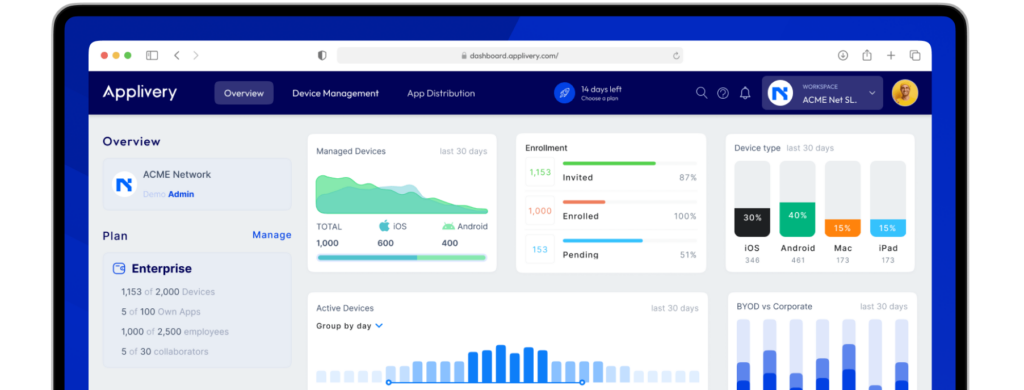
Applivery fills the gap left by the simultaneous exit of Meraki SM and Microsoft App Center by merging enterprise-grade MDM with agile app delivery.
-
Unified Device Management: consolidate the administration of Android, Apple, and Windows devices from a single, intuitive console, eliminating the need for fragmented, siloed management tools.
-
Security & compliance: fortify your fleet with granular controls, including remote device wiping, restriction of unapproved applications, and full enforcement of security policies to maintain compliance with GDPR and HIPAA.
-
DevOps integration: native CI/CD pipelines (GitHub, Jenkins) automate the delivery of “builds” to internal testers in minutes.
-
Private enterprise repository: total control over app versioning and life cycles without the friction of public app stores.
Accelerated migration methodology (zero-downtime)
A core part of our Meraki exit strategy is a proven methodology that completes the transition in 2 to 4 weeks, far shorter than the 3-6 month industry standard.
| Phase | Technical milestone | Timeline |
|---|---|---|
|
Planning |
Expert mapping of Meraki policies to Applivery templates and SSO integration. |
Week 1 |
|
Pilot |
Deployment to 50-100 devices to validate critical app performance. |
Week 2 |
|
Execution |
Batch migration with a device re-enrollment gap of only 5 to 15 minutes. |
Weeks 3-4 |
Financial optimization: 40% TCO savings
A truly effective Meraki exit strategy should be a financial catalyst, not just a risk mitigation measure. By moving away from legacy pricing models, organizations can leverage our transparent, usage-based licensing to unlock significant budgetary efficiencies.
-
Quantifiable cost reduction: IT leaders transitioning from Meraki SM to Applivery consistently achieve a 30% to 40% reduction in their Total Cost of Ownership (TCO) over a three-year horizon.
-
Operational ROI: beyond direct licensing, our advanced automation—including Dynamic Audiences and Policy Composition—drastically lowers the “hidden costs” of fleet management by reducing manual support tickets and shortening deployment cycles from months to days.
Secure your infrastructure today
Don’t wait for the 2026 deadline to lose your bargaining power or risk your security posture. Transition to a platform that offers stability, DevOps agility, and a customer-centric culture.
Ready to start your evaluation?
-
Risk assessment: we will help you map your current Meraki SM policies to Applivery.
-
14-day technical trial: full access to our API and automation features.
Frequently Asked Questions (FAQ)
What are the primary risks of delaying the migration until the 2029 deadline?
Postponing action until the end of support in June 2029 exposes your organization to unpatched security vulnerabilities and the risk of non-compliance with critical regulations like GDPR, HIPAA, or SOC 2. Additionally, waiting until the limit reduces your bargaining power and increases the risk of a rushed, unmanaged transition.
How does Applivery ensure a "Zero-Downtime" transition during migration?
Our methodology guarantees that devices remain managed throughout the process. The transition gap—the time between unenrolling from Meraki SM and re-enrolling in Applivery—is typically reduced to just 5 to 15 minutes per device, ensuring continuous operation.
What is the real financial impact of switching from Meraki to Applivery?
The move is a financial optimization that achieves a 30% to 40% reduction in Total Cost of Ownership (TCO) over a three-year period. This is driven by a transparent, usage-based licensing model and the reduction of manual IT support hours through advanced automation.