

In 2026, the gap between identifying an operational need and deploying a technical solution has become the primary capital drain for B2B companies. Organizations face a triple pressure: a 16.6% increase in cybersecurity incidents, unprecedented technological fragmentation, and a demand for immediacy that traditional IT models simply cannot meet.
In this context, Applivery emerges as the essential catalyst to break the operational “bottleneck,” transforming device management from a bureaucratic hurdle into a driver of autonomy for business units.
From operational bottleneck to business autonomy
The root problem identified in our recent analysis of The State of Endpoint Management is “intermediation friction”. Every hour a plant or logistics manager loses waiting for a technical update is an hour of financial latency.

The answer for 2026 is not to train all staff in MDM protocols, but to implement an abstraction layer. This allows business users to manage the “intent” of their assets—app deployment, compliance status, immediate rollbacks—while the platform absorbs the technical complexity of mixed architectures (Android, iOS, Windows).
Delegating execution and centralizing governance
There is a well-founded fear that democratizing management might compromise security. However, Gartner data indicates that by 2026, 10% of large enterprises will operate under mature Zero Trust models.
This standard allows companies like Applivery to offer a shared responsibility model where security is not a barrier, but an invisible infrastructure:
| 2026 Friction Point | Legacy Approach (IT-Only) | Adaptive Approach (Business Autonomy) | Strategic Value |
|---|---|---|---|
|
App deployment |
Cycles of days via tickets. |
Instant self-service. |
Continuity: 60% reduction in administration time. |
|
Crisis management |
Centralized reactive response. |
Autonomous field rollbacks. |
Resilience: proactive mitigation against rising attacks. |
|
Scalability |
Linear cost growth. |
API-First automation. |
ROI: maximizing endpoint lifecycle. |
Building resilience without vendor dependency
To avoid vendor lock-in, leading organizations are migrating toward modular infrastructures. A modern platform must be, above all, a tool for digital sovereignty that allows for the reconstruction of workflows without depending on the unilateral decisions of hardware giants.

By integrating DevOps capabilities directly into endpoint management, we allow business software to reach end devices at the same speed it is developed, eliminating the manual processes that typically stifle innovation in large fleets.
Want the full picture? If you wish to explore the technical and strategic data redefining the sector, we invite you to consult our full report:
Applivery as a strategic speed asset
Device management in 2026 has moved beyond an inventory task to become a decision about organizational speed. As Forrester highlights, digital experience and technical autonomy are now the pillars defining the most competitive companies in the B2B market. Applivery doesn’t just simplify this transition; it ensures your business moves as fast as your ambition.
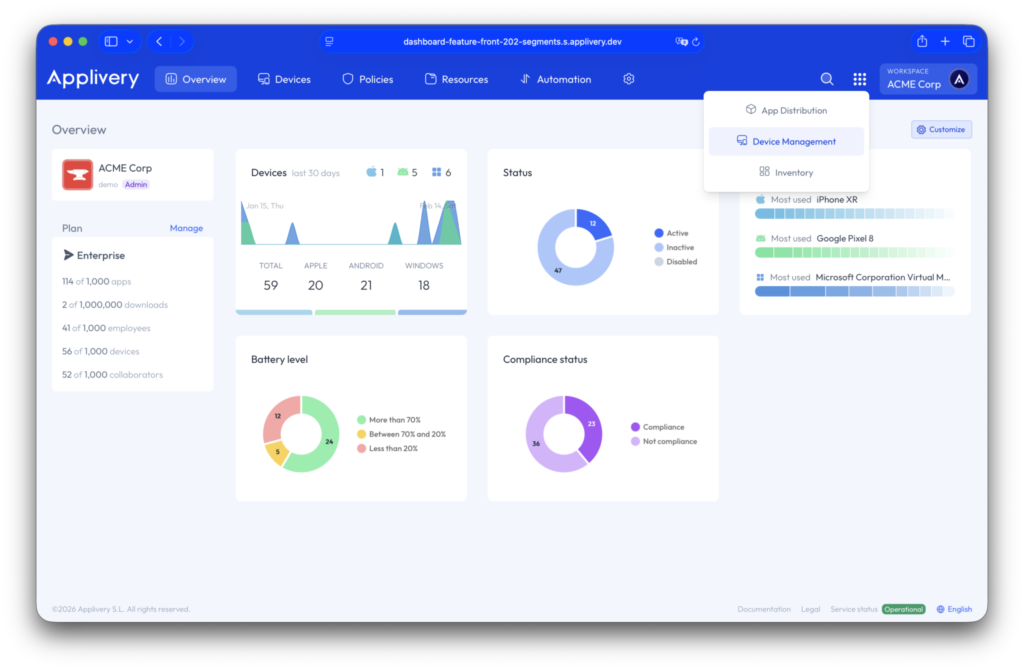
A Unified Endpoint Management (UEM) solution like our platform allows you to centralize and automate these controls across iOS, Android, macOS, and Windows devices from a single console.The organizations already operating under modular and sovereign architectures aren’t waiting for the perfect moment, they started. See how companies like yours are transforming their device management with Applivery.
Frequently Asked Questions (FAQ)
How does Applivery guarantee security while granting autonomy to business users?
Autonomy is not a lack of control, but rather efficient execution. The Applivery model is built on a centralized governance framework where IT defines Zero Trust policies and compliance infrastructure (GDPR/HIPAA). Business users operate within this secure, predefined "sandbox," allowing for rapid response without compromising the company’s perimeter security.
What is "Zero-Touch Onboarding"?
It is the ability to ship hardware directly to an employee, who simply turns it on to have it configured automatically via technologies like Apple DEP or Android Zero-touch. By removing the requirement for devices to physically pass through the IT department, logistical bottlenecks are eliminated, and remote fleets reach peak productivity from the very first minute.
What does "Complexity Abstraction" mean in the context of device management?
It does not mean simplifying or removing features; rather, it refers to creating a software layer that absorbs the technical disparities between different operating systems (iOS, Android, Windows). This allows business users to execute strategic actions through an intuitive interface, while Applivery automatically manages the underlying technical protocols required by each hardware manufacturer.