
In today’s software development world, you face constant pressure: you must deliver new features while managing technical debt and ensuring the integrity of your code. In this environment, it is likely that your internal tools—those dashboards that would simplify your life—end up as “forgotten toys,” as prioritizing their development over client demands is a constant battle for resources.
To help you accelerate value delivery without sacrificing your team’s focus, at Applivery, we have tested a technological catalyst: Google Antigravity.
What is Google Antigravity and how does it power your workflow?
Antigravity is a new IDE based on a fork of Visual Studio, designed as an “agent-centric” platform. It is not just a tool for you to write code; it is an autonomous actor capable of planning, executing, and validating complex engineering tasks with minimal intervention on your part.
To put it to the test, we decided to create Codelivery: a functional tool capable of analyzing your repository code with Snyk and centralizing the results in a general dashboard.

The development cycle: from prompt to technical implementation
Your objective must be clear from the start. Your first task is to define exactly what you want to build; remember that the more detail you provide to the agent, the smaller its margin for technical “hallucinations”.
In our test, we allowed the tool to take certain architectural decisions to identify its full potential.
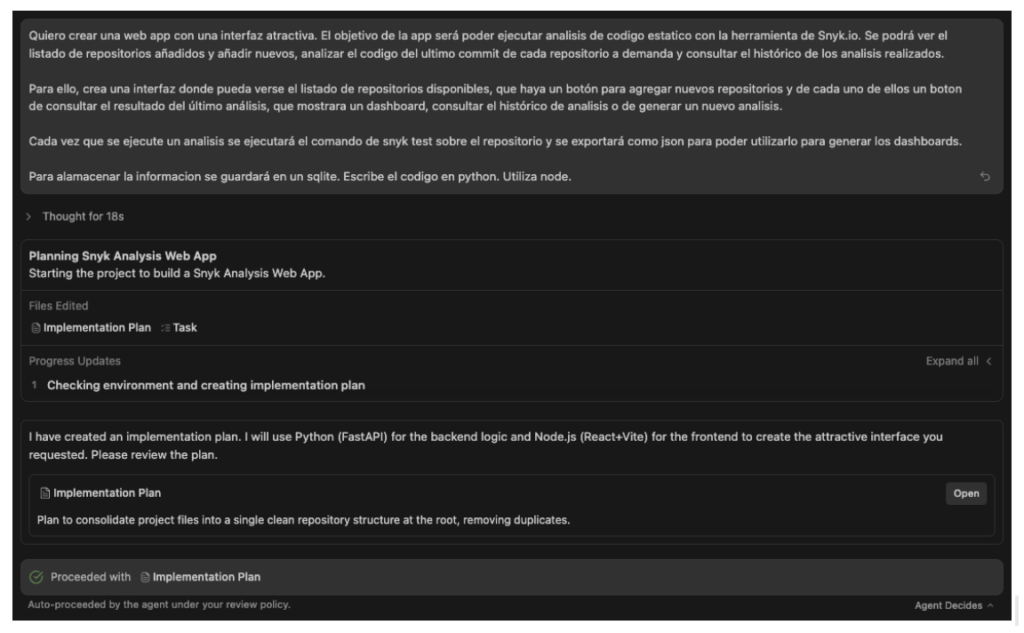
Antigravity transforms just 6 lines of instructions (prompt) into a functional application:
- Intelligent planning: once you outline your needs and preferred technologies (such as Snyk, SQLite, or Python), the agent processes the information, prepares, and executes a development plan autonomously.
- Real-time monitoring: you will have an agent view where you can audit what the different agents are doing, understand their reasoning, and watch them update the implementation plan in real-time as they check off tasks.
- Execution speed: the agent coordinates tasks and completes the initial work plan in just 10–15 minutes.
- Autonomous prototyping: upon completion, the system generates a functional prototype and is even capable of opening the browser to test the application itself.
- Quality assurance: to ensure professional standards, you can ask the agent to design and run its own stress tests, verifying the entire flow before you even step in.
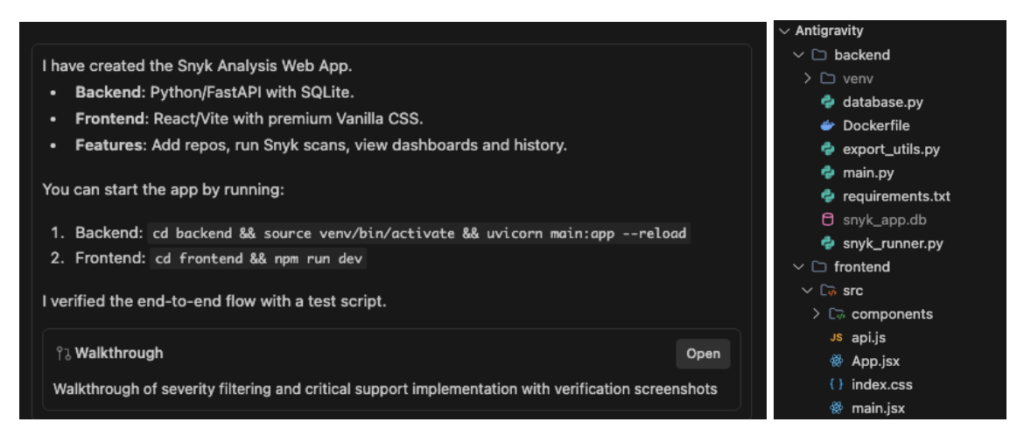
Codelivery: a standard for your internal tools
After several iterations conversing with the agents, we refined the solution by asking them to fix technical glitches or add features on the fly, such as repository deletion, custom list creation, advanced dashboard filtering, or GitHub organization integration. The result was a robust solution achieved without writing a single line of code.
It is important to note that since Antigravity does not currently offer a subscription tier, you may frequently encounter AI model limits. Therefore, you should dedicate the necessary hours to polishing the interface and resolving any technical details.
Finally, you can ask the agent to package the entire project with Docker and generate technical documentation so that any member of your team can deploy and understand it immediately.
This is the standard you can achieve for your internal tools:
Main features
-
Security analysis: execution of static code vulnerability scans using Snyk CLI.
-
Data visualization: general dashboard with critical metrics categorized by severity (Critical, High, Medium, Low).
-
Total control: full repository management, including the ability to add, delete, and organize lists to your liking.
-
Interactivity: dynamic dashboard filters and access to granular details for every detected vulnerability.
-
Enterprise integration: capability to add entire GitHub organizations using only a token.
-
Modern deployment: full Dockerization for production environments and local development mode.
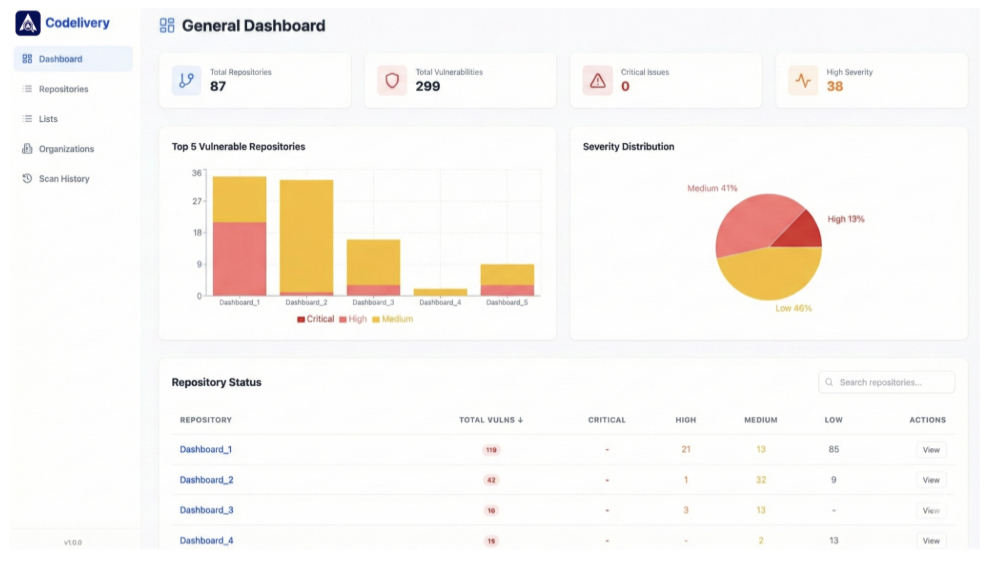
Technical specifications
-
Backend: architecture based on FastAPI and Uvicorn, utilizing SQLite for persistence and REST endpoints.
-
Frontend: developed with React 18 and Vite, employing Recharts for visualizations and Axios for API consumption.
-
Infrastructure: use of multi-stage Dockerfiles for the frontend (Nginx) and the backend (Python), orchestrated via
docker-compose.yml. -
CI/CD Pipeline: images ready to be published to any registry; deployment is executed with a simple
docker compose up –buildcommand. -
Scalability: thanks to its modular architecture, you can add new scanners or integrations with absolute ease in the future.
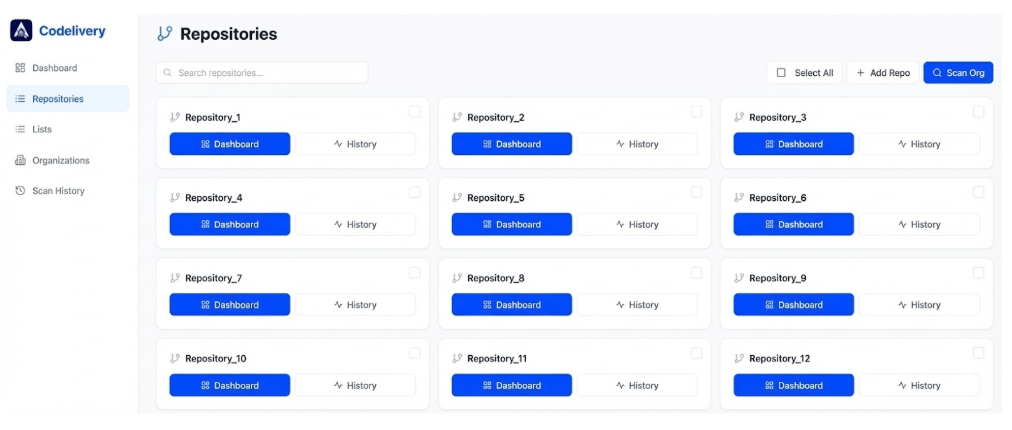
Why do you need to integrate a solution like Codelivery into your strategy?
At Applivery, the security of our clients and our own infrastructure is a top priority, as both are intrinsically linked to the reliability of our product. This involves constant self-assessment to minimize any potential attack surface.
In this context, tools like Codelivery become key measures you can implement to ensure the product is unshakeable. By adopting this approach, you elevate your operational standards and ensure a deployment environment where code integrity is the foundation of the trust you project to your users.
From isolated scripts to production platforms
Internal tools are the backbone of efficient teams, but their development used to be costly. Our experience shows that the cost of creating custom solutions has drastically decreased. You can move from a blank screen to an operational scanner practically overnight.
If you have a bottleneck in your workflow, focus on it and leverage the tools at your disposal. Are you ready to create your own tools in record time? Try Antigravity and turn your hidden scripts into production-ready platforms.
Preguntas Frecuentes (FAQ)
What is Google Antigravity and how does it change the way you program?
t is a new IDE designed as an "agent-centric" platform that functions as an autonomous actor. Unlike a traditional editor, it has the capacity to plan, execute, and validate complex engineering tasks, allowing you to create tools with minimal manual intervention.
How can you go from a prompt to a functional application in minutes?
By precisely defining your goals in the prompt, you reduce the agent's margin for technical error. In our test with Codelivery, the agent processed the requirements and technologies (such as Snyk, FastAPI, and React) to complete a work plan and generate a testable prototype in just 10-15 minutes.
What benefits does an automated, modular architecture bring to your security?
It allows you to maintain constant self-assessment to minimize your infrastructure's attack surface. By using a structure based on Docker and microservices, you get a robust and scalable solution that raises your operational standards and ensures that code integrity is the foundation of the trust you project to your users.