

Device management is no longer purely an operational concern. For years, UEM platforms focused on solving problems around inventory, deployments, and remote support. But the landscape has changed fundamentally.
Today, endpoints are one of the primary attack vectors for any organization. Corporate laptops, smartphones, tablets, and remote work devices concentrate access to critical information, digital identities, and strategic applications. That has turned endpoint management into a decision directly tied to security, regulatory compliance, and business continuity.
In this new reality, organizations are no longer looking for tools to manage devices: they are looking for platforms that reduce risk, streamline audits, and protect data over the long term. That is where Applivery UEM comes in a unified endpoint management platform with ENS high category certification, NIS2 and GDPR compliance, and native post-quantum cryptography, all from a single cloud console.
From device control to endpoint governance
The traditional MDM model was built to solve a logistics problem: how to distribute apps, push configuration profiles, and maintain device inventory across a fleet. That problem still exists, but it is no longer what differentiates one platform from another.
What sets platforms apart today is the ability to answer questions that once belonged exclusively to the CISO: Can the organization demonstrate compliance in an audit? Are devices aligned with NIS2, ENS, or DORA? What happens to data encrypted today in the face of future threats? Those questions cannot be answered with a traditional MDM. Modern UEM must function as a transversal layer of security and governance, not just an administration tool.

Regulatory frameworks shaping endpoint security today
The table below summarizes the key frameworks already requiring organizations to actively manage the security of their endpoints:
| Framework | Scope | Who it applies to | Endpoint implication |
|---|---|---|---|
|
NIS2 |
European Union |
Critical infrastructure, digital service providers |
Mandatory risk management across the technology supply |
|
ENS Categoría Alta |
Spain |
Public sector and its suppliers |
Most demanding level for critical information systems |
|
GDPR |
European Union |
Any organization processing EU citizens’ data |
Protection of personal data on corporate devices |
|
DORA |
European Union |
Financial sector and ICT providers |
Digital operational resilience, ICT risk management |
|
ISO 27001 |
International |
Any organization certifying information |
Asset control, access management, and device security |
How Applivery addresses each regulatory requirement
Below are the Applivery UEM capabilities that directly respond to the security and compliance requirements that matter most to organizations today:
| Capability | What it does | What it solves for the business |
|---|---|---|
|
Certificación ENS Categoría Alta |
Accredits compliance with the most demanding level of the Spanish security framework |
Eliminates pre-qualification audits in public procurement processes |
|
Native post-quantum cryptography (PQC) |
Quantum-resistant encryption independent of the device operating system |
Protects long-lived data against the “Harvest Now, Decrypt Later” threat model |
|
Cybersecurity Made in Europe |
European cloud infrastructure with certified data sovereignty |
Meets GDPR requirements and eliminates uncertainty about data residency |
|
Centralized compliance control |
Consistent security policies across all devices with continuous verification |
Simplifies audits and reduces regulatory risk surface |
|
Zero-Touch deployment |
Automated device provisioning from first power-on |
Eliminates manual errors and ensures secure configuration from the start |
The risk that cannot wait: “Harvest Now, Decrypt Later”
Talking about post-quantum cryptography can still sound futuristic, but the reality is that it already sits at the top of the agenda for international standards bodies and leading cybersecurity teams worldwide.
Many threat actors are already harvesting encrypted data today, with the intent to decrypt it in the future once quantum computing reaches sufficient capacity. This attack model, known as “Harvest Now, Decrypt Later” poses particular risk to organizations that handle information with a long useful life: public administrations, healthcare, defense, financial services, and critical infrastructure.

The question is no longer whether post-quantum cryptography will be necessary. The question is when it will be too late to begin the transition. Institutions including NIST, the European Union, and the UK’s NCSC have been driving that transition for years. Applivery is the first UEM to have delivered it in production.
Which organizations need UEM with advanced compliance
Public sector and government agencies
Entities subject to ENS that need to demonstrate compliance of their tooling to external auditors. The key argument: ENS High Category certification is a baseline condition, not the outcome of an adaptation process.
Financial and insurance sector
Organizations subject to DORA that must demonstrate digital operational resilience and ICT risk management across their supply chain. They need centralized visibility and control over all endpoints accessing critical systems.
Healthcare and critical infrastructure
Organizations handling data with a long useful life that need to demonstrate not only current compliance but future readiness. Post-quantum cryptography protects today the data that will still be sensitive ten years from now.
Suppliers to the public sector or large enterprises
Companies that receive security requirements as a contractual condition. Their device management tooling needs to meet the same audit standards as the rest of their security stack.
NIS2, quantum computing, and the new role of UEM
A clear trend is reshaping enterprise cybersecurity: endpoint management is migrating from the IT department into the domain of the CISO. NIS2 has accelerated that shift in Europe, extending risk management obligations to the technology supply chain. Organizations can no longer outsource responsibility for device security — they are directly accountable to regulators, customers, and partners.
In parallel, the quantum threat has moved from a theoretical concern to an institutional priority. Organizations including NIST, the UK’s NCSC, and the European Union have been driving the transition to quantum-resistant cryptographic algorithms for years.

The most recent signal: Android 17 is integrating post-quantum cryptography natively at the operating system level. When the world’s most widely used mobile OS adopts PQC as part of its core architecture, IT leaders can no longer treat it as an emerging trend. The standard has changed.
Organizations that begin the transition earlier start with an advantage. This is not just about protecting devices, it is about protecting critical information for the years ahead.
More security and compliance does not mean more operational complexity
One of the main barriers to adopting advanced UEM platforms is the perception that adding layers of security and compliance translates into greater burden for the IT team. The reality is the opposite.
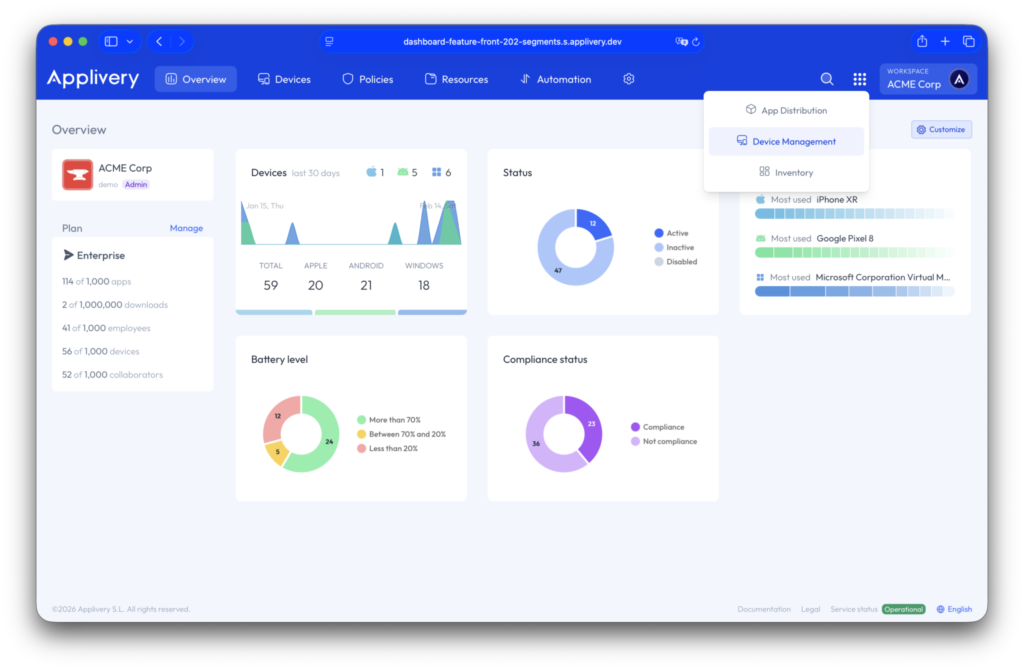
Applivery is built so that advanced security policies activate transparently, without requiring changes to existing IT workflows or the end-user experience. Consolidating management, security, and compliance into a single platform reduces integrations, eliminates failure points, and simplifies audits. When everything works in an integrated way, the IT team gains visibility, control, and responsiveness without increasing its operational load.
Get started with Applivery UEM
Applivery has the certifications and security architecture to meet the most demanding regulatory requirements. If you want to see how it fits your organization, our team is available to talk.
Frequently Asked Questions (FAQ)
Which regulatory frameworks does Applivery UEM cover?
Applivery UEM is aligned with the major security and compliance frameworks: ENS High Category (Spain), NIS2 (European Union), GDPR, and DORA. The Cybersecurity Made in Europe seal certifies that the infrastructure meets European standards for privacy and data sovereignty.
For organizations that require ISO 27001 compliance, the platform provides the asset control and device management capabilities the standard demands.
What is the Esquema Nacional de Seguridad (ENS) and why does it matter for the public sector?
ENS is the Spanish regulatory framework that establishes security requirements for public administration information systems and their suppliers. The High Category is its most demanding level.
Applivery is certified at this level, which removes the need for pre-qualification audits in public procurement and streamlines the qualification process for technology providers working with the public sector.
How does Applivery help organizations comply with NIS2?
NIS2 requires organizations in critical sectors to actively manage security risks across their technology supply chain, including employee devices.
Applivery supports this compliance through consistent security policies, continuous device compliance verification, complete endpoint traceability, and advanced encryption all from a single cloud console without on-premise infrastructure.
What is post-quantum cryptography and why does it matter now?
Post-quantum cryptography (PQC) refers to encryption algorithms designed to resist attacks from quantum computers. It matters now because the “Harvest Now, Decrypt Later” threat model allows bad actors to capture encrypted data today and decrypt it once quantum computing reaches sufficient capacity.
Organizations handling sensitive information with a long useful life like healthcare, defense, financial services face a present-day risk, not just a future one. Applivery is the first UEM to have integrated PQC natively in a production environment.
Do I need on-premise infrastructure to deploy Applivery?
No. Applivery is 100% cloud-based, running on European infrastructure that meets GDPR data sovereignty requirements. Zero-Touch activation allows devices to join the fleet with the correct security and compliance configuration from first power-on, without manual intervention from the IT team.