
We are proud to announce that Applivery has definitively unified App Distribution and Endpoint Management. This is a native blending that enables the direct deployment of your Custom Applications (Custom Apps) to Fully Managed Android devices at the UEM policy level.
We are the first UEM worldwide to bridge the gap between App Distribution and Endpoint Management using Google’s AMAPI, delivering a 100% compliant, end-to-end workflow.
What are Custom Apps and why is their deployment critical?
In the B2B landscape, Custom Applications are no longer just tools; they are the most critical software assets driving a company’s competitive advantage. Unlike public store apps, these are purpose-built solutions designed to automate complex industrial workflows, manage real-time inventory, or empower field teams with mission-critical data.
However, the success of these applications depends on bridging a historical divide:
- DevOps Agility: The need to continuously and automatically distribute new builds via CI/CD.
- IT Control: The mandate to ensure only compliant, secure versions reach devices under strict UEM policies.
Bridging this gap has traditionally forced organizations into a “fragmentation trap,” relying on a patchwork of siloed tools that create operational bottlenecks and compromise security through decentralized control.
Because legacy UEM solutions lack a developer-centric DNA, they cannot manage internal app lifecycles with the necessary sophistication. This disconnect results in a friction-filled environment where IT teams struggle to enforce consistency while developers are slowed down by manual deployment hurdles.
By unifying these two worlds into a single, compliant ecosystem, Applivery eliminates the operational lag and compliance risks inherent in disparate platforms, allowing your business to move as fast as your code.
The App Distribution Engine inside Applivery UEM
Our Developer-Centric DNA and our App Distribution engine are the foundation that allows us to integrate application lifecycle management with endpoint control.
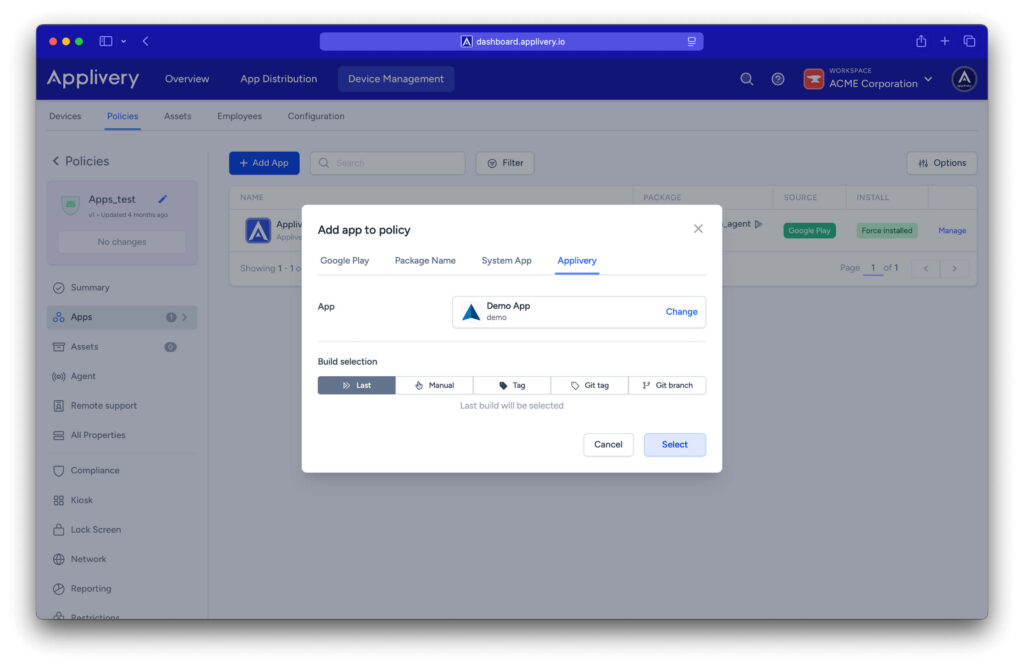
This new capability allows you to Assign a Deployed App Build at the Policy Level, directly from the Apps section in your UEM Policies.
Smart Build selection with total control
Now, your IT team can benefit from the power of Applivery’s distribution with flexible selection options, ensuring the right build reaches the right endpoint:
- Latest available version: automatic deployment of the application’s most recent build.
- Manual build selection: precise control by choosing a specific version.
- Custom tags: deploy builds intended for specific testing groups or environments (staging, production).
- Code repository integration (Git Tag and Git Branch): connect distribution directly to your development workflow, deploying builds based on Git tags or branches.
Configuration path
The process is intuitive and performed from the UEM console, making deployment as simple as assigning any other application:
- Go to Policies and select the policy where you want to deploy a Custom App.
- Navigate to the Apps section.
- Click + Add App.
- Select the Applivery tab and choose the app and build you want to deploy.
Elevating Patch Management to an unprecedented level
This unification does more than just simplify deployment; it elevates Patch Management to a level of control previously unattainable in the B2B industry. By merging the developer’s pipeline with the IT policy, we are effectively eliminating the “last mile” gap that has historically left enterprise devices vulnerable.
Zero-Day Patching for internal software
In critical environments, a bug in a custom app isn’t just an inconvenience—it’s an operational risk. Traditionally, “Zero-day” protection was reserved for OS updates. Now, Applivery enables Zero-day patching for your own code. As soon as a critical fix is committed to your repository, it can be automatically pushed to managed devices via AMAPI policies, ensuring that the gap between “code fixed” and “device secured” is reduced to zero.
Absolute software governance and risk elimination
This is the end of “fragmented control”. By assigning specific builds, Git tags, or branches directly to UEM policies, IT administrators achieve total software governance. You are no longer just installing an app; you are enforcing a specific, validated state across your entire fleet. This removes the risk of version mismatch, untested builds reaching production, or legacy vulnerabilities lingering in the field.
The end of the Dev-IT gap
The “fragmentation trap” used to mean that DevOps worked in a vacuum and IT worked in a silo. Applivery’s unified architecture creates a frictionless continuum.
For DevOps: the policy becomes an extension of the CI/CD pipeline.
For IT: distribution becomes a native, automated security protocol rather than a manual task.
| Value area | Fragmented solutions | Applivery UEM |
|---|---|---|
|
Patch deployment time |
Slow and manual. Requires coordination between App Distribution and UEM. |
Immediate and automated. The update is automatically triggered by the UEM policy after the release in the Applivery repository. |
|
Version control and deployment |
Divided control. High risk of deploying incorrect or untested builds. |
Total control. Granular build selection by Git Tag or Custom Tag directly in the UEM Policy. |
|
Operational resilience |
Fragile workflow, susceptible to manual errors. |
Modular and API-first workflow. The DevOps strategy is more robust and not susceptible to single-vendor dependency. |
|
Android compliance |
Risk of using workarounds or non-compliant solutions in AMAPI. |
100% Fully compliant with Google’s AMAPI, ensuring the security and control required by regulations (GDPR, HIPAA). |
Streamline your Android operations today
This is the final strategic step in our mission to offer a platform that unifies security (for IT) and agility (for Development). Your development team automates its releases, and your IT team applies critical patches and versions with maximum confidence and speed.
It’s time to experience the true convergence of App Distribution and Endpoint Management!
Request a Demo and see how Applivery unifies your IT and DevOps operations.
Frequently Asked Questions (FAQ)
What makes Applivery’s Custom App deployment "fully compliant"?
Our deployment process is built natively on Google’s Android Management API (AMAPI). This ensures that every application distributed to Fully Managed devices follows official Google security standards and enterprise-grade protocols, eliminating the risks associated with non-official or fragmented deployment methods.
How does this feature benefit DevOps teams specifically?
It bridges the gap between development and distribution. DevOps teams can now leverage our sophisticated App Distribution engine to automate the delivery of internal "builds" directly into UEM policies. This includes native integrations with CI/CD tools and the ability to deploy specific versions based on Git tags or branches.
How does this improve Patch Management for industrial environments?
In industrial or mission-critical settings, downtime is not an option. By unifying App Distribution with Endpoint Management, critical security patches and app updates are triggered immediately at the policy level. This eliminates the manual "build-to-device" lag, ensuring your fleet is always up to date and compliant.