


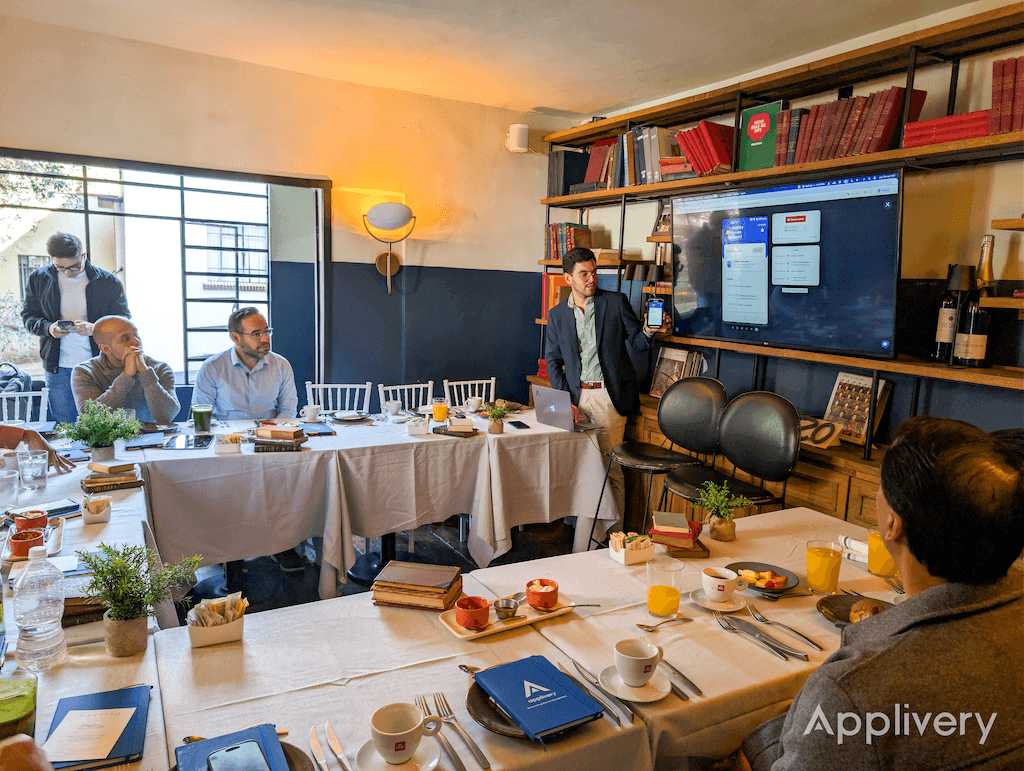
Over the past few months, I have had the opportunity to support Applivery’s commercial growth in Mexico and take part in conversations with customers, partners, and IT teams managing increasingly distributed operations.
This direct contact with the market has helped me identify a recurring need across industries such as aviation, hospitality, retail, and logistics. Companies increasingly depend on their devices, yet many still manage them through manual processes or tools that can no longer keep pace with the complexity of their operations.
In these environments, devices are no longer simply workplace tools. The iPads used by pilots, terminals deployed across hotels, point-of-sale equipment, and rugged devices used in warehouses are now an integral part of everyday operations.
When one of these devices fails, the impact goes beyond an IT incident. It can affect a flight, the service provided to a guest, a sale, or the performance of an entire logistics operation.
From manual management to scalable operations
Nearshoring, hybrid work, and the expansion of distributed operations are increasing the number of devices that Mexican organizations need to manage.
At the same time, requirements around security, traceability, regulatory compliance, and operational continuity are becoming more demanding. IT teams must manage larger and more diverse fleets, often with limited resources and devices distributed across different cities, workplaces, or even countries.
The question is no longer simply how to configure a device. The real challenge is managing its entire lifecycle, from initial provisioning and application distribution to security policy deployment, updates, employee reassignment, and remote wiping.
All of this must be achieved without increasing the IT team’s workload or disrupting users’ daily activities.
Three priorities consistently emerge from our conversations in Mexico: automation, fast implementation, and accessible support in Spanish.
Companies are not simply looking for a platform with a long list of features. They need a solution that can be deployed quickly, adapts to the actual scale of their operation, and is backed by a team that understands the urgency of their business.
Real projects in environments where failure is not an option
Applivery’s growth in Mexico is supported by projects developed alongside organizations operating in particularly demanding environments.
Volaris and The Excellence Collection belong to very different industries, but they share the same operational pattern: business-critical devices, geographically distributed operations, and IT teams that cannot afford disruption.
Volaris and the management of 1,300 critical iPads
Volaris, one of the leading low-cost airlines in Mexico and Latin America, uses iPads as Electronic Flight Bags for its pilots. These devices are a critical part of flight operations and must remain updated, protected, and ready to provide access to operational documentation at all times.
As the airline expanded, its existing device management platform could no longer meet its needs. Device setup also took approximately 90 minutes per iPad. Volaris needed to migrate more than 1,300 iPads distributed across several regions. The contract with its previous provider was close to expiring, and the transition had to be completed without disrupting a single flight.

The Applivery team supported Volaris throughout the migration. Within a few weeks, 90% of the devices had been migrated without affecting operational continuity.
Beyond completing the transition, the IT team gained greater visibility into the status of every iPad and the ability to manage the entire fleet centrally, regardless of where each device was located. The employees who had previously been dedicated to manual device configuration could also be reassigned to more strategic business activities.
“We were looking for a tool that unified control and reduced complexity. Today, we have operational visibility that we did not have before, ensuring that every pilot has the tools they need, kept up to date and protected under the aviation industry’s security protocols.”
Richard Miguel González Martínez, Senior IT Infrastructure Manager at Volaris
The Excellence Collection and a two-day deployment
The Excellence Collection is a luxury hotel group with nine resorts located in Mexico, the Dominican Republic, and Jamaica. In this type of environment, devices are not isolated from the service delivered to guests. They are an integral part of the guest experience and the daily work carried out by hotel employees.
Before implementing Applivery, many device management tasks were performed manually. Updating devices required physically collecting them, working on each one individually, and redistributing them afterward. Preparing all the equipment for the opening of a new property could take more than a week.e trabajo para configurar todos los equipos.
The turning point came when the company needed to prepare more than 200 devices for the opening of a new hotel. With Applivery, the deployment was completed in just two days.
Applications and configurations are now distributed centrally. When devices connect, they automatically receive the updates defined by the IT team, without travel, physical device collection, or service disruption.
The company has also strengthened control over its fleet by restricting access to application stores, blocking unauthorized downloads, managing Wi-Fi networks, and remotely locking devices when necessary.
“Before, we had to collect every device to update it. Now, with Applivery, we simply upload the update to the policy, and it is automatically replicated across all the hotels.”
Christyan Fernandez, IT Support at The Excellence Collection
A need that extends across other industries
Aviation and hospitality have been two important drivers of Applivery’s growth in Mexico, but the need for centralized device management extends well beyond tourism.
In retail, IT teams must keep point-of-sale terminals, PDAs, tablets, and in-store devices operational across hundreds of locations. Updates must be deployed without interrupting business activity, particularly during peak trading periods.
In logistics and distribution, employees use rugged devices in warehouses, distribution centers, and field operations. Many of these devices operate in environments with limited connectivity and are located far from the technical teams responsible for maintaining them.
The same challenge also appears in organizations with high employee turnover. Devices frequently change hands, and IT must ensure that every reassignment is completed quickly and securely.
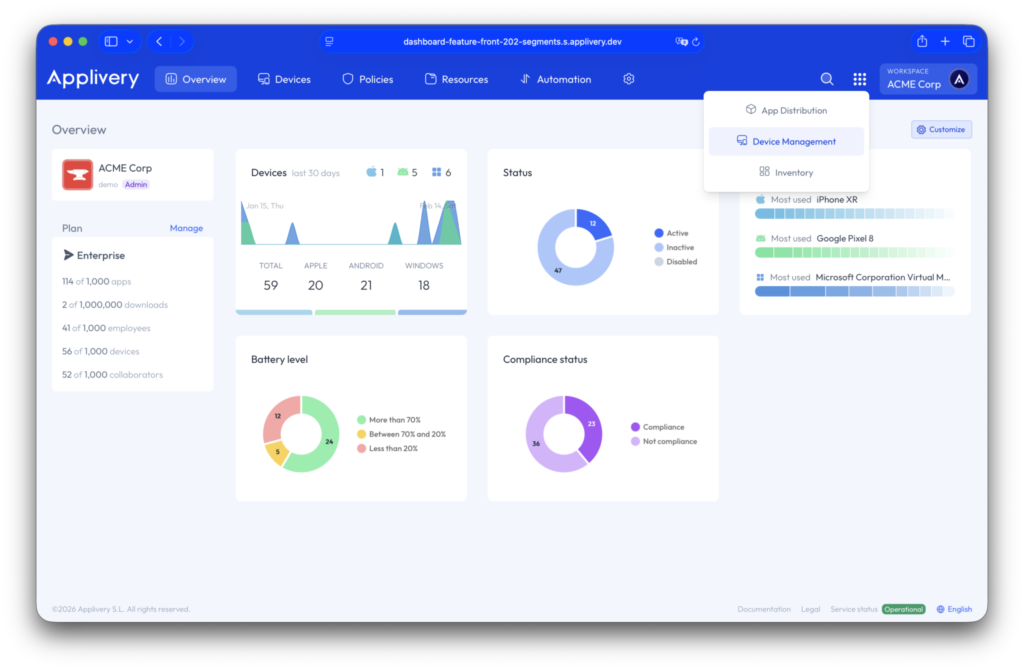
Automating provisioning, configuration, and remote wiping is no longer simply an additional advantage. It has become an operational requirement.
The ability to recover devices when users no longer know their security PIN is also important, helping companies avoid unnecessarily replacing equipment that can still be securely reused. Across all these scenarios, the objective is the same: replacing individual and reactive device management with a centralized, automated, and scalable model.
Global technology with local support
One of the first questions companies ask when we introduce Applivery in Mexico is rarely about the platform’s technical capabilities. It is about support.
Organizations want to know who will be available when an issue arises, whether they can receive support in Spanish, whether assistance will be available during their working hours, and whether the team supporting them will understand the urgency of their operation. That is why our proposition in Mexico goes beyond providing a technology platform.
Applivery’s growth in the country is also supported by close guidance during implementation, collaboration with IT teams, support in Spanish, and partnerships with organizations that understand the specific requirements of the local market.
This human element is particularly important during complex migrations. Technology makes it possible to automate and scale, while close support helps organizations complete the transition with less risk and achieve visible results from the earliest stages of the project.
Mexico as a strategic market for Applivery
Mexico is a key market within Applivery’s growth strategy in Latin America. This is not only because of the size of the market. It also reflects the maturity of the companies modernizing their infrastructure, the importance of industries with distributed operations, and the growing need to manage expanding device fleets more efficiently.
After taking part in these commercial conversations, I have reached a clear conclusion: Mexican companies do not simply need to manage more devices. They need an infrastructure that allows them to grow without adding complexity, disruption, or additional pressure on their IT teams.
Volaris and The Excellence Collection demonstrate how centralized device management can transform very different operations. An airline can migrate critical devices without interrupting its activity, while a hotel group can reduce the time required to prepare equipment for a new opening from more than a week to just two days.
The industry may change, the type of device may change, and the scale of the operation may vary. However, the underlying need remains the same: visibility, security, automation, and control from a single platform.
Bring this model to your own operations
Managing a distributed fleet should not require configuring devices individually, traveling between locations, or relying on manual processes to keep applications and policies up to date.
With Applivery, IT teams can manage Android, Apple, and Windows devices from a single platform, automate recurring tasks, and maintain control throughout the entire device lifecycle.
Whether an organization is managing its first device fleet or overseeing operations distributed across several countries, the platform adapts as the business grows and helps teams achieve results from the earliest stages of implementation.
Learn how Applivery can support your device management strategy. Talk to our team.