

Google I/O 2026 signals a new phase for businesses: AI agents, apps built with less friction, new Android XR devices, and growing pressure on endpoint management.
AI is no longer limited to answering questions. It is starting to build applications, assist with processes, work directly on corporate data, and follow users across more devices. For businesses, this opens up a clear opportunity. It also adds a new layer of complexity for IT and cybersecurity.
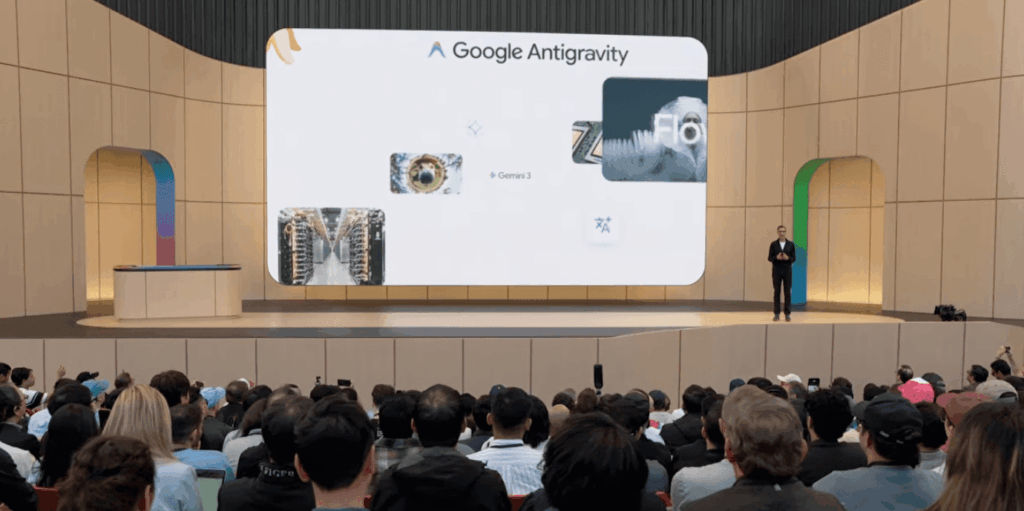
The latest Google announcements point in that direction. More capable models, agent-driven development, Android apps built with less friction, AI embedded in Workspace, new XR devices, and tools to verify synthetic content. The point is not just what AI can do, it is how everything it sets in motion gets governed.
The shift is also visible in how people search and work with information. According to Google, queries in AI Mode are longer, more conversational, and more multimodal than traditional searches. For businesses, this points toward a more natural relationship with technology but also more activity across data, applications, and devices.
What Google I/O 2026 means for IT and cybersecurity
Over the past few years, many organizations have adopted AI for specific tasks: summarizing documents, drafting replies, generating ideas, translating content, or speeding up searches. That use case is still valuable, but it is starting to fall short of what is coming.
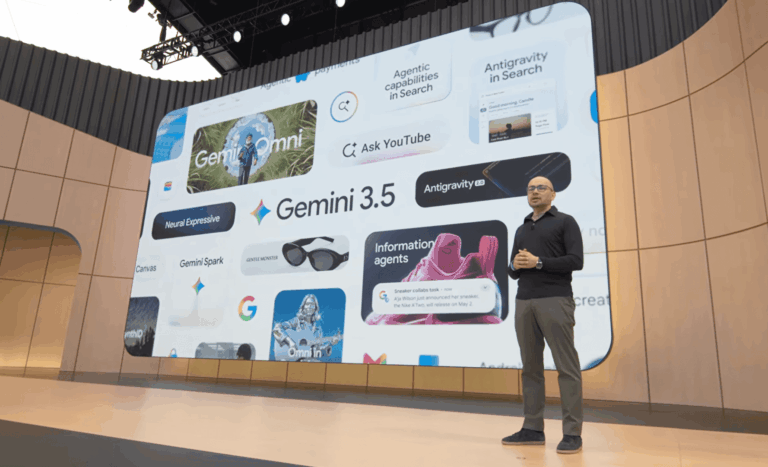
With Gemini 3.5 Flash, Google Antigravity, AI Studio for Android apps, Workspace AI, Android XR, and SynthID/C2PA, the conversation is moving to different ground. AI is beginning to participate in software development, application creation, task automation, work on corporate information, and digital content verification.
This directly affects the endpoint. A device is no longer just the point from which an employee accesses an app. Increasingly, it is where identity, data, automation, internal applications, AI agents, and security decisions all converge. The smarter that environment becomes, the more important it is to manage it with intention.
The Google I/O 2026 announcements with the greatest B2B impact
These announcements signal meaningful changes for IT, development, cybersecurity, and device management.
| Announcement | Why it matters in B2B | Implication for IT and endpoint management |
|---|---|---|
|
Gemini 3.5 Flash |
AI for long-horizon tasks, development, auditing, and automation |
More AI-assisted processes that will need oversight, traceability, and governance |
|
Google Antigravity |
Agentic and multi-agent development |
Faster software cycles, with greater need to manage versions, testing, and deployments |
|
AI Studio for Android apps |
Building Android apps becomes easier |
More internal applications to distribute, control, and keep updated |
|
Workspace AI / AI Inbox / Docs Live |
AI embedded in everyday work tools |
Greater exposure of corporate data from user devices |
|
Android XR / intelligent eyewear |
New devices for field operations |
New endpoints to inventory, configure, protect, and monitor |
|
SynthID / C2PA |
Digital trust against synthetic content |
Greater need to secure the environments where information is created, consumed, and shared |
unlimited trial of Applivery
Gemini 3.5 Flash: deeper automation in business processes
Gemini 3.5 Flash is positioned as a model built for complex, long-running tasks. Google places it in scenarios like application development, code maintenance, financial document preparation, and building more interactive interfaces.
For businesses, that is not a minor detail. AI is beginning to play a role in processes that previously required more time, more coordination, and more manual effort. For IT, this may mean more speed but also more digital assets to manage.
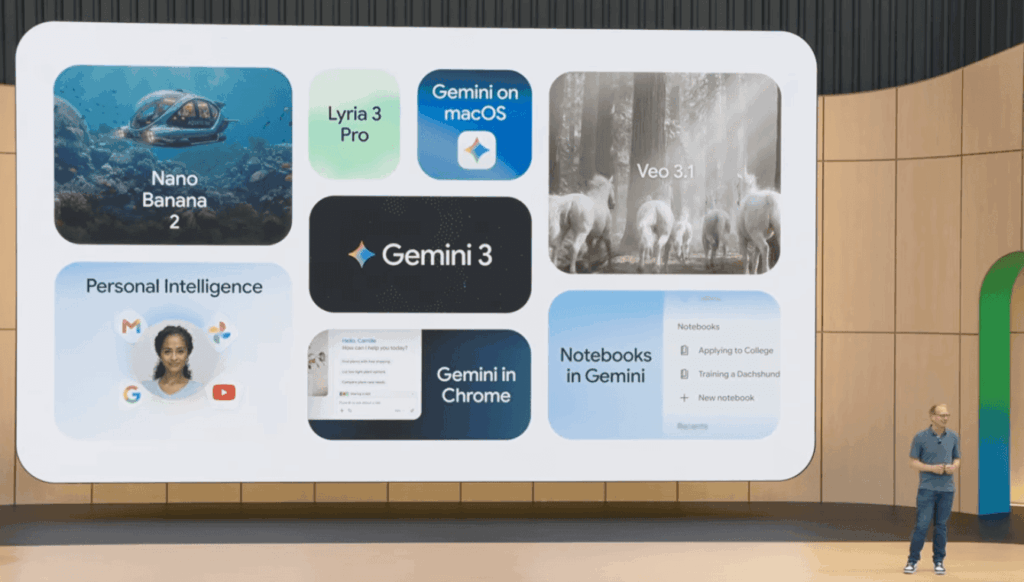
If teams can build internal solutions faster, the number of applications, prototypes, integrations, scripts, and automated workflows in circulation will also grow.
The question will no longer be just what AI can do, but how to control what AI helps create.
Antigravity: agentic development and new delivery cycles
Google Antigravity oints toward a development model where agents can work in parallel, execute tasks, generate artifacts, and assist with technical processes. For development, DevOps, QA, and product teams, this can shorten timelines and make it easier to build internal solutions.
But accelerating development does not eliminate the need for control. An application built faster still needs review, testing, version management, permissions, secure distribution, and retirement when it no longer meets internal requirements.
Many organizations do not just have a software creation problem. They have a lifecycle problem: how to move an app from prototype to testing, from testing to production, and from production to a specific device fleet without losing traceability. As agentic tools gain ground, that lifecycle will need tighter governance.
AI Studio for Android apps: building will be easier, managing will not
The ability to create native Android apps directly from AI Studio is one of the most relevant announcements for companies with mobility needs field services, logistics, retail, technical support, or highly specific internal processes.
Building an Android app could become faster and more accessible. That opens up opportunities to digitize workflows that have long been stuck in spreadsheets, manual forms, or tools poorly suited to mobile work.
But inside an enterprise, building the app is only part of the challenge. After that, it needs to be distributed, assigned to the right users, tested on real devices, version controlled, kept away from production until it is ready, and updated or retired when needed.
Not all Android environments are the same. Many organizations work with rugged devices, shared tablets, industrial terminals, devices without Google Mobile Services, or Android Open Source environments. In those cases, app management cannot rely solely on the public app store. Enterprise app distribution becomes a critical part of the IT strategy.
Workspace AI: productivity with greater exposure of corporate data
AI Inbox, Docs Live, and other Workspace updates show how Google wants to bring AI directly into email, documents, tasks, and daily workflows.
For the user, this can reduce friction, prioritizing messages, drafting replies, structuring documents, or connecting scattered information. For security, it means AI is working increasingly close to sensitive corporate data. That is why the endpoint matters.
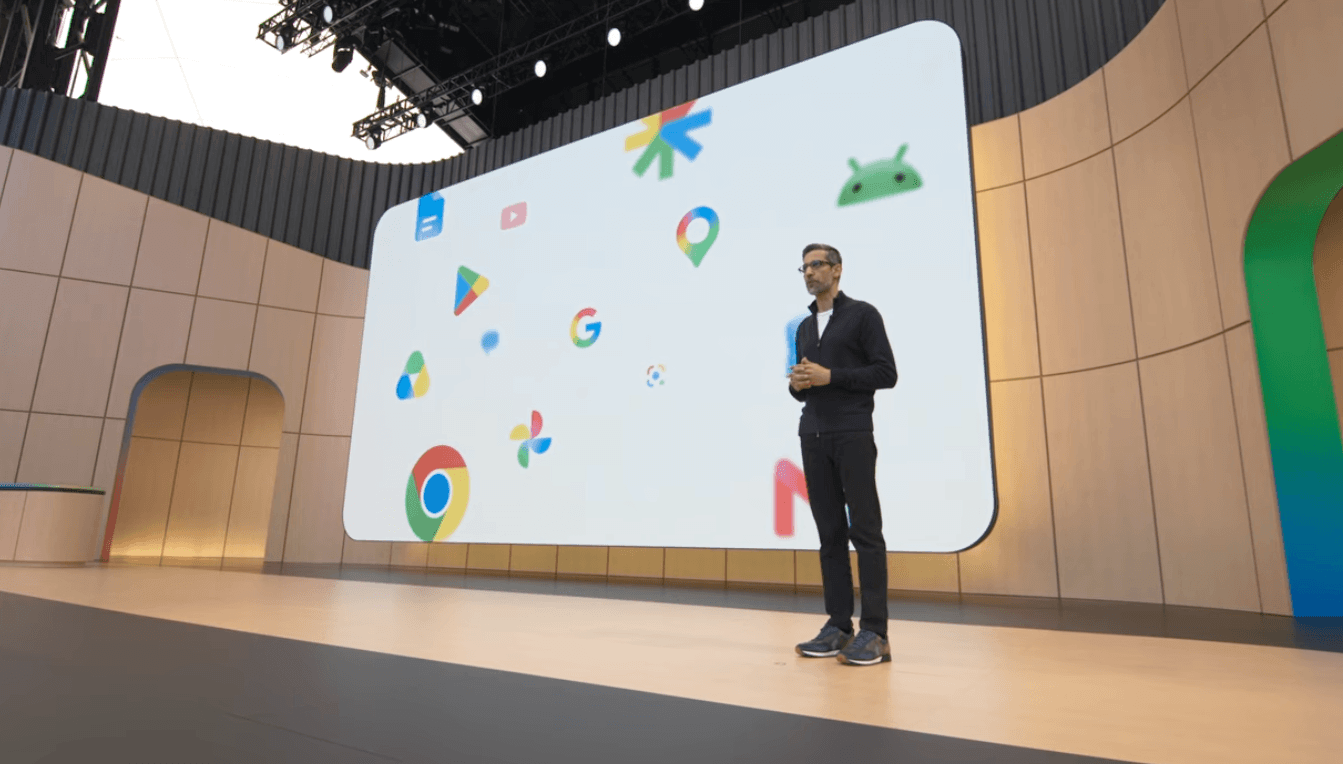
Protecting a user’s account is not enough on its own. The device used to access Gmail, Drive, Docs, Calendar, or any corporate environment also needs to be secured. A device without encryption, without a screen lock, running an outdated OS, or operating outside policy can become a weak point even when access is protected at the identity layer.
AI assisted productivity will need to be supported by devices that are managed, up to date, and aligned with the organization’s security policies.
Android XR and intelligent eyewear: the endpoint expands
Android XR and smart glasses point to a new device category that can make a lot of sense in operational environments.
In field services, industrial maintenance, logistics, retail, or healthcare, hands-free devices can allow workers to receive instructions, look up information, or interact with systems without stopping what they are doing.
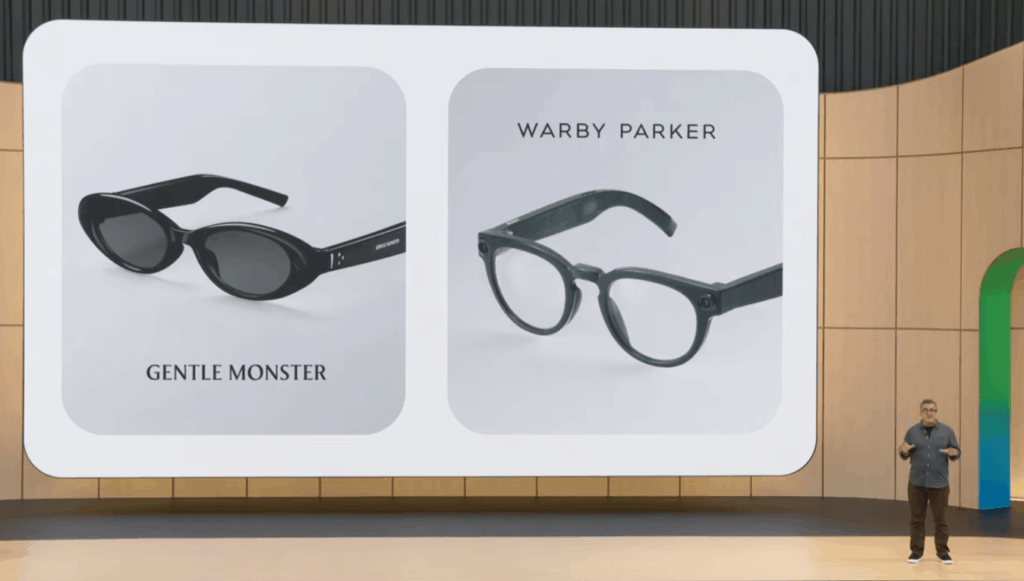
This is where IT starts to have new work. Every new device format expands the management surface. The enterprise endpoint is no longer just the laptop or the smartphone. It can also be a shared tablet, a rugged device, smart glasses, an Android Open Source terminal, a kiosk, a wearable, or a specialized device connected to a critical process.
The more the endpoint diversifies, the less sustainable it becomes to manage it through manual processes or siloed tools.
SynthID and C2PA: digital trust in a world of synthetic content
The advances in SynthID and C2PA Content Credentials point to another significant challenge: verifying the origin and integrity of content in an environment where synthetic generation will become increasingly common.
This has implications for communications, legal, training, support, security, HR, and brand protection teams. It is not just about detecting deepfakes or manipulated content. It is also about knowing whether a document, image, video, or audio file can be used with confidence inside a corporate process.
For cybersecurity, digital trust does not start and end with the file. It also depends on the environment where that content is created, downloaded, shared, or consumed. Once again, the device is a critical link in the chain.
Where IT should focus from here
The Google I/O 2026 announcements do not require businesses to change everything at once. But they do anticipate questions that IT teams will need to answer more frequently:
- Which internal applications are being built, and how are they being distributed?
- Which devices can access AI-assisted corporate data?
- Which app versions are installed on each device?
- What happens if an app generated or modified with AI does not meet internal policies?
- How are Android devices outside the traditional Google ecosystem managed?
- What new endpoints might appear in field operations?
- How is the security posture of devices accessing Workspace verified?
- What controls exist over the tools, apps, and data employees are using?
These are not theoretical questions. They are the natural result of an environment where AI accelerates the creation, automation, and distribution of technology inside the enterprise.
From the intelligent endpoint to the governed endpoint with Applivery
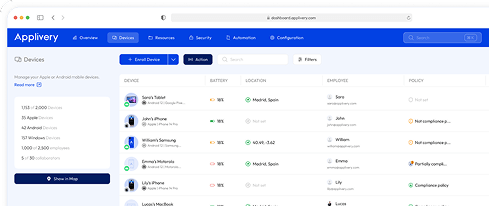
At Applivery, we help IT teams manage this complexity from a unified UEM platform, combining device management, application distribution, cybersecurity, and automation.
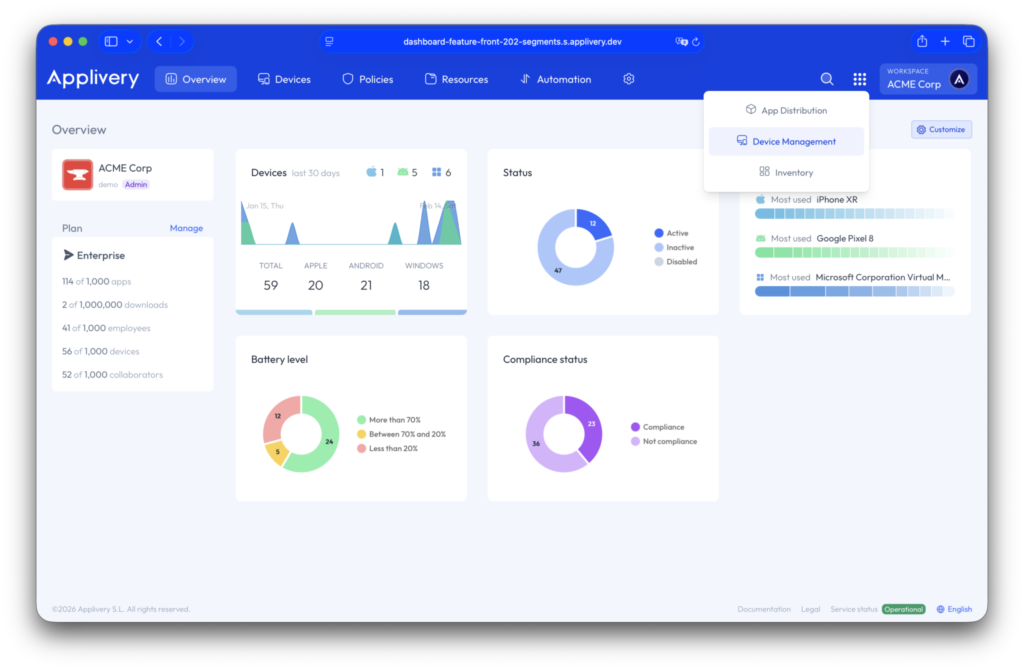
This makes it possible to address some of the scenarios these announcements anticipate:
- Manage Android, Android Open Source, Apple, and Windows devices from a single environment.
- Distribute corporate applications in a controlled way, for both testing and production.
- Control versions, access, and updates across distributed fleets.
- Apply security policies based on device, group, segment, or context.
- Maintain visibility over endpoint health, especially in mobile, shared, or field environments.
- Automate responses when a device falls out of compliance.
- Reduce manual processes as device or application volume grows.
The goal is not to add more complexity to IT, it is to give it a layer of control over an increasingly dynamic environment. If AI accelerates application creation, if Android XR introduces new devices, and if Workspace brings AI closer to corporate data, businesses will need a more solid way to govern the endpoint.
he next step: governing the intelligent endpoint
The enterprise is moving toward an environment with more agents, more automation, more AI-built applications, and more devices connected to critical processes.
The opportunity is significant — but it also demands more control. Adopting new tools is not enough if IT does not have visibility over the devices, applications, and data in play.
The enterprise endpoint will keep getting smarter. The difference will lie in how it is governed. At Applivery, we help IT teams manage, protect, and automate their device fleets from a unified UEM platform.
Ready to prepare your environment for what comes next? Talk to our team today.
Frequently Asked Questions (FAQ)
What Google I/O 2026 announcements are most relevant for businesses?What Google I/O 2026 announcements are most relevant for businesses?
The announcements with the greatest B2B impact are Gemini 3.5 Flash, Google Antigravity, AI Studio for Android apps, Workspace AI, Android XR and intelligent eyewear, and SynthID/C2PA. All of them touch on development, productivity, application management, new devices, or cybersecurity.
How is AI changing enterprise endpoint management?
AI is beginning to play a role in more business processes: application development, automation, productivity, information retrieval, and content verification. That raises the stakes for the endpoint, because it is where users, data, applications, agents, and security decisions all come together.
Why does Gemini 3.5 Flash matter for IT?
Because it is built for long-running, complex tasks like development, automation, code maintenance, and document preparation. This can accelerate internal processes, but it also demands more control over what gets built, tested, and distributed.
What changes with AI Studio for Android apps?
AI Studio can make it easier to build native Android applications. For businesses, this can speed up the development of internal tools but it also makes it more important to manage distribution, version control, testing environments, and deployment to real devices.
What does Android XR mean for device management?
Android XR expands the concept of the enterprise endpoint to include smart glasses, hands-free devices, and new form factors for field operations. These devices will also need to be inventoried, configured, secured, and kept under corporate policy.
Why does Workspace AI increase the importance of endpoint security?
Because AI is now working directly on email, documents, tasks, and corporate files. If that data is accessed from unmanaged or insecure devices, the risk increases. Security needs to account for identity, application, data, and device, all at once.
How does Applivery help in this new landscape?
A UEM platform like Applivery makes it possible to centralize device management, application distribution, policies, and automation. In an environment with more AI, more internal apps, and more device types, it helps IT maintain visibility, control, and security without relying on manual processes.