

194 days. That’s how long organizations take, on average, to detect a data breach. Of those breaches, 68% involve an unmanaged endpoint. This isn’t a tooling problem or a budget problem. It’s a visibility problem.
Security policies are in place, compliance rules configured, EDRs and SIEMs deployed, allowlists defined the capabilities exist. But the reality is that the problem often starts much earlier. What good is any of that if you don’t have full control over your entire device fleet? One endpoint flying under the radar leaves everything else exposed.
This is the reality Jaime Desviat, Head of Cybersecurity at Applivery, brought to the table at the ASLAN Cybersecurity & AI Trends Forum, held recently in Madrid one of Spain’s leading cybersecurity gatherings for IT and security decision-makers. His session was among the best-rated presentations at the event, making the case for a fundamental shift in how organizations think about device security.

What Is Exposure Management in endpoint security
Exposure Management in endpoints is a continuous, autonomous framework that allows IT and security teams to discover, assess, prioritize, remediate, and prove compliance across every device in their fleet without relying on reactive, incident-driven workflows.
Unlike traditional MDM or UEM solutions, which focus on pushing configurations to devices, Applivery operates as an Autonomous Endpoint Management (AEM) platform that proactively reduces attack surface before threats materialize.
Managed doesn't mean secure
Traditional endpoint management was built around a simple loop, something goes wrong, you detect it, you react. Patch, reset, isolate. The problem is that this model assumes someone will step in and act on that detection and often, they don’t.
The shift Applivery advocates isn’t just a product upgrade it’s a change in operating model. The MDM/UEM logic pushes configurations and waits for incidents. Modern Endpoint Management (EMM) improves on that with better tooling. But Autonomous Endpoint Management goes further: it removes the assumption that IT needs to be in the loop for every decision. Routine exposure gets handled automatically. The team focuses on what genuinely requires human judgment automated updates and remediations, automatic device isolation when at risk, live visibility into fleet status, all powered by artificial intelligence.
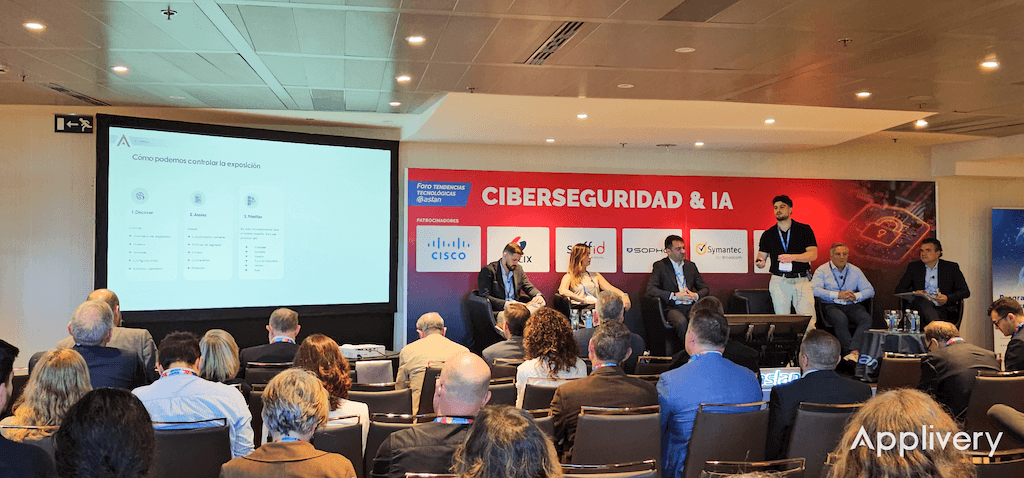
As Desviat put it at the ASLAN Forum: “You can’t protect what you can’t see, prioritize what you don’t understand, or act from a position of ignorance.”
The five-stage framework for controlling attack surface
| Stage | What it does | What IT teams gain |
|---|---|---|
|
Discover |
Continuous inventory of devices, users, OS versions, configurations, and installed apps |
Full fleet visibility, no blind spots |
|
Assess |
Automated evaluation against the security baseline: encryption, passwords, policies, updates |
Real-time compliance gaps, no manual audits |
|
Prioritize |
Risk ranking by criticality, context, device type, user role, OS version, and app |
Focus on what actually matters, without the noise |
|
Remediate |
OS and app updates, access revocation, device isolation, notifications |
Automatic exposure correction without opening tickets |
|
Prove |
Dashboards, reports, and audit trails tracking risk evolution over time |
Evidence ready for auditors and regulators |
Discover: build a real inventory, not a spreadsheet
The starting point is knowing what exists. Devices, users, OS versions, configurations, installed applications all of it. Not as a one-time audit, but as a continuously updated picture. Most organizations have partial inventories. Applivery makes complete asset discovery the default state, not a project.
Assess: evaluate compliance before the auditor does
Once you know what’s out there, you need to measure it against your security baseline. Are devices encrypted? Are password policies enforced? Are security policies active? Are operating systems up to date? Assessment turns raw inventory into actionable compliance data — the gap between what should be true and what actually is.
Prioritize: know which risk demands immediate attention
This is where most teams lose time. They see a list of 300 violations and don’t know where to start. Applivery prioritizes by criticality, context, device type, user role, OS version, and application risk. A non-compliant device belonging to an executive with access to financial systems is a different problem from an unregistered tablet in a break room. The platform helps you treat them differently.
Remediate: take action, don't open tickets
Visibility without action is just documentation. Remediation means pushing OS and application updates, revoking access where appropriate, isolating compromised devices, applying configuration changes, and notifying users — all triggered by the same platform that detected the issue. Routine remediation actions happen without waiting for a ticket to be opened and assigned.
Prove: demonstrate compliance with continuous data
Security posture isn’t just an internal concern. It’s an audit requirement, a regulatory obligation, and increasingly a commercial expectation.
This stage is about generating the evidence: dashboards, reports, audit trails, and risk evolution data that show compliance over time — not just at a single point-in-time snapshot.
Who benefits most of Exposure Management
Organizaciones con datos de larga vida útil que necesitan demostrar no solo cumplimiento actual sino preparación futura. La criptografía post-cuántica protege hoy los datos que seguirán siendo sensibles dentro de diez años.
| Profile | The problem Applivery solves |
|---|---|
|
Enterprise IT with mixed fleets (Android, iOS, Windows, macOS) |
Unified management of all five stages from a single console, without switching tools by device type |
|
BYOD or hybrid work environments |
Full security coverage without invasive control over personal data, through self-service enrollment and work profile separation |
|
Teams under regulatory pressure (NIS2, ENS, ISO 27001) |
Continuous reporting and audit trails ready for any inspection, no last-minute scramble |
|
Distributed IT or resource constrained teams |
Automated routine remediation frees the team from repetitive operational tasks to focus on higher-impact decisions |
Why the endpoint Is the foundation, not an afterthought
The ASLAN Forum framed this year’s cybersecurity conversation around resilience: the question is no longer whether a breach will occur, but how quickly an organization can detect, respond, and recover. Gartner projects global IT security spending will grow nearly 10% in 2026, surpassing $6 trillion.
Applivery’s participation at the event positioned Exposure Management in endpoints not as a supporting player in this story, but as its foundation. Advanced threat intelligence tools, SIEMs, cloud monitoring, and EDRs all assume that the devices feeding data into those systems are known, inventoried, and at least minimally controlled. When they’re not and the 68% unmanaged endpoint figure suggests they often aren’t the entire security stack operates on incomplete information.
The move from reactive MDM to Autonomous Endpoint Management is, in this sense, a prerequisite for making everything else work.
More exposure control doesn't mean less employee autonomy
A recurring concern when organizations consider expanding visibility or giving employees self-service capabilities is the fear of losing administrative control.
Applivery’s architecture addresses this directly: the self-service portal gives users access to corporate data and approved applications within a boundary defined by IT, not in spite of it. Employees get a better experience. IT retains full control over what’s available, what’s enforced, and what’s monitored.
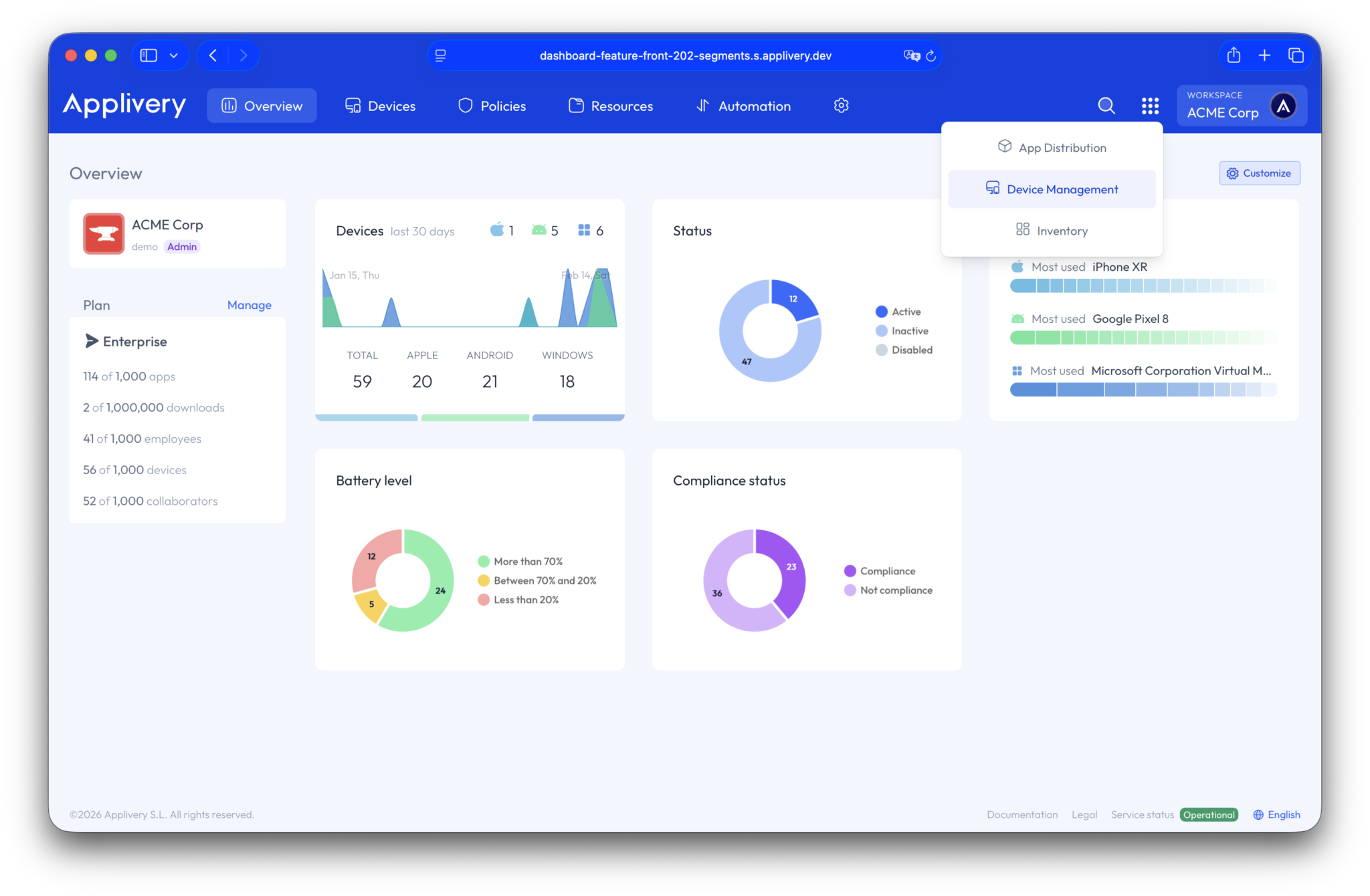
Remote support, policy enforcement, and device isolation capabilities remain entirely in IT’s hands.
Analyze your fleet with Applivery
If this framework resonates with the challenges you’re facing in your own environment, the next step is seeing how it applies to your specific device fleet and use case.
If you’re evaluating whether your current MDM setup gives you the visibility and control you actually need, Applivery’s team is available to walk through your environment.
Frequently Asked Questions (FAQ)
What is Exposure Management in endpoints and how does it differ from traditional MDM?
Exposure Management in endpoints is a continuous approach to identifying, assessing, and reducing attack surface across every device in an organization's fleet before incidents occur. Traditional MDM focuses on pushing policies and configurations to enrolled devices. Exposure Management goes further: it inventories all assets (including unmanaged ones), continuously evaluates compliance, prioritizes risk by context and criticality, automates remediation where possible, and generates audit-ready evidence. Applivery's AEM (Autonomous Endpoint Management) platform operationalizes this full cycle from a single console.
What platforms does Applivery's Exposure Management support?
Applivery supports Android (including Fully Managed and Work Profile modes), iOS, iPadOS, macOS, and Windows from a single unified platform.
Available capabilities may vary depending on the platform and enrollment mode — for example, certain geolocation policies behave differently in Android Work Profile compared to Fully Managed mode. Refer to Applivery's platform-specific documentation for accurate details on each configuration.
How does Applivery handle Shadow IT and unauthorized applications?
Shadow IT — applications running on corporate or BYOD devices without IT's knowledge or approval — is one of the primary drivers of uncontrolled attack surface.
Applivery's Discovery layer surfaces installed applications across enrolled devices, giving IT visibility into what's actually running versus what's approved. The corporate app catalog and enterprise store offer employees a structured alternative to downloading unauthorized tools, while policy enforcement can restrict or block applications that don't meet security requirements.
Is autonomous remediation safe? Who decides which actions run automatically?
Autonomous remediation in Applivery operates within rules and thresholds defined by IT administrators. The platform doesn't act outside the boundaries of what has been configured and approved. Routine actions — such as pushing an OS update to devices below a minimum version threshold, or revoking access from a device that has been out of compliance for a defined period — can be automated. Higher-impact actions, such as full device wipe or network isolation, remain under explicit IT control. Automation removes operational burden; it doesn't remove IT's authority.
What compliance frameworks does Applivery support for the Prove stage?
Applivery's reporting and audit capabilities are designed to generate evidence for the most common regulatory and security frameworks, including NIS2, ENS (Esquema Nacional de Seguridad), and ISO 27001, among others.
The platform provides dashboards, exportable reports, and risk evolution tracking over time. For specific framework mapping or audit preparation support, contact the Applivery team directly.