

User management is a core component of App Distribution in Applivery. It ensures that the right users have the correct level of access to projects, apps, and the Enterprise Store.
Applivery divides users into two main categories: Collaborators and Store employees.
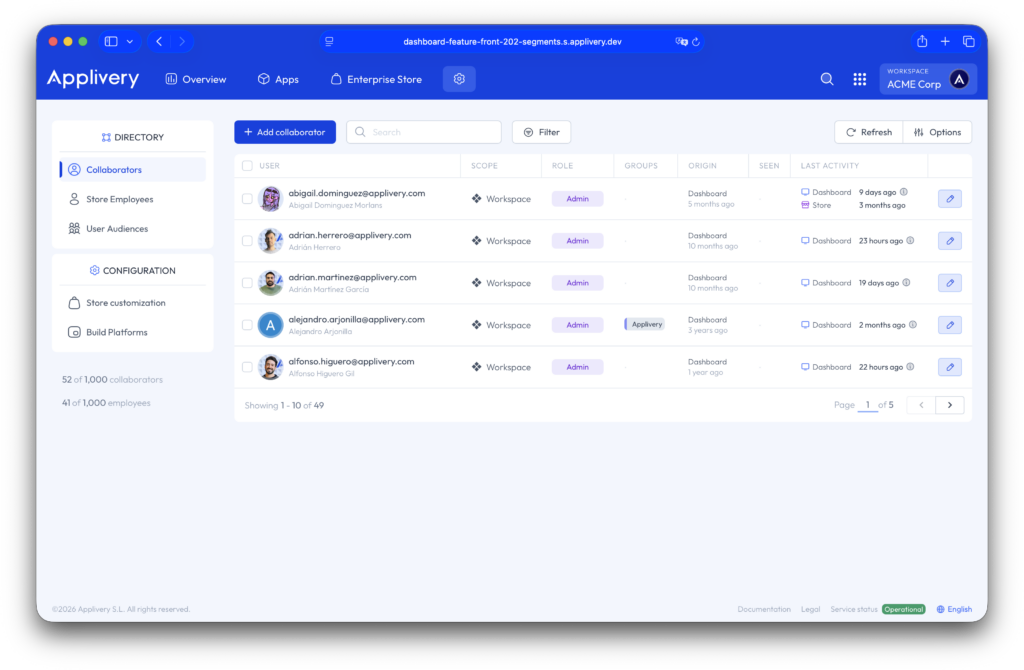
Collaborators #
Collaborators are users with administrative permissions over your projects (Apps) and workspace. They have different levels of access to the Dashboard and the App Store based on their role:
Role
Description
Owner
Super-administrator of your workspace. Only one per workspace.
Admin
Manages developers. Full administrative permissions over Apps, and Workspace except Billing.
Editor
Can upload builds. Read-only access to Distribution and Settings. No access to Billing. Cannot remove devices.
Viewer
Read-only permissions for all resources except Billing, People, and Settings.
Unassigned
No access to any resources at the workspace level, but can be assigned roles at the app level.
Store employees #
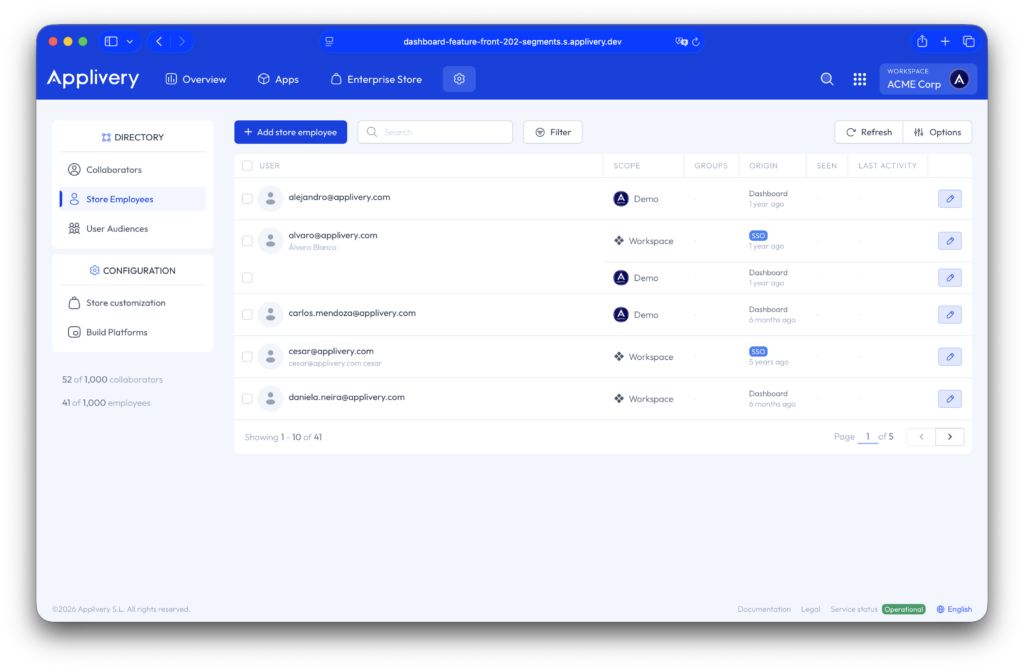
Store employees represent each end-user who access your apps via the Enterprise Store. Store employee accounts can be customized both at the App and Organization levels.
They are divided into five origins, depending on how the employee record was created:
Origin
Description
Dashboard
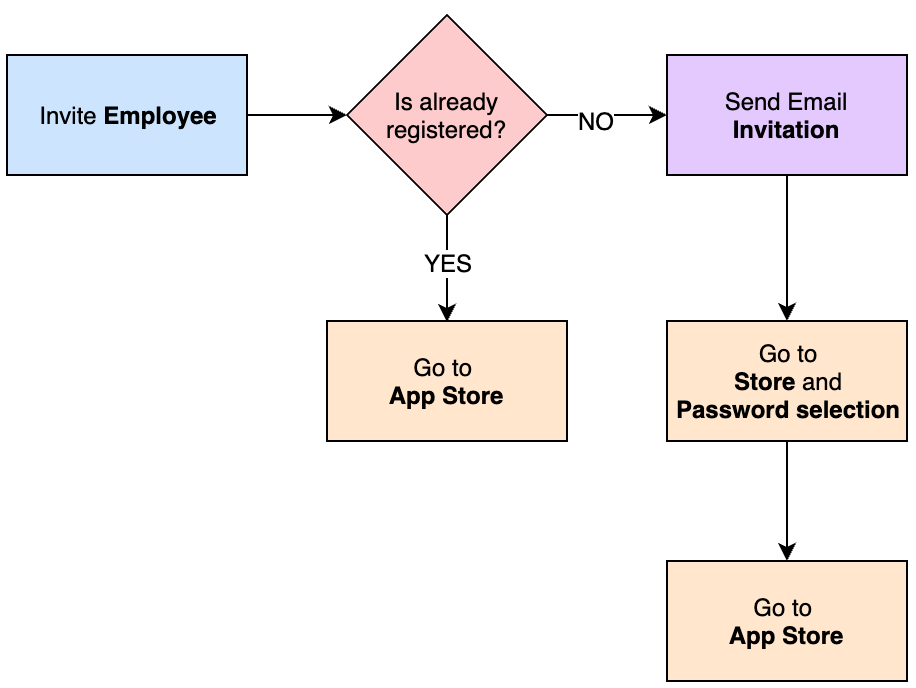
Employees invited from the Dashboard. They receive an email to register their account and access the App Store.
SSO
Employees automatically created when logging into the App Store using Single Sign-On.
SDK
Named employees (with at least a known email) created programmatically using the Applivery SDK bindUser() method.
SDK temporal
Unknown users automatically created by the SDK to identify a device. They are unique per workspace based on device ID and expire after 30 days of inactivity within your Apps.
Store employees form the end-user layer, and their access can be controlled using Groups, User Audiences, and app-specific permissions.
Groups and User Audicences #
- Groups: Static collections of store employees manually created by administrators. Useful for department-based distribution, temporary project teams, or controlled rollout scenarios.
- User Audiences: Dynamic groups automatically populated based on store employee attributes or activity. They simplify large-scale app distribution and policy application by automatically updating membership.
Applications can be targeted to individual employees, Groups, and User Audiences.
This ensures precise and secure distribution, controlled rollouts, and compliance with internal policies.
User activity overview #
User activity provides a clear view of last login and last action for each user, whether a Collaborator or Store employee.
- Logins update both the last login and last action timestamps.
- Other actions (build uploads, app installs, etc.) update the last action timestamp.
Best practices #
- Assign Collaborators according to the principle of least privilege.
- Use User Audiences for dynamic app targeting and scalability.
- Regularly review Store employee activity to maintain a clean and secure workspace.
- Combine Groups and Audiences for hybrid distribution strategies.
How to invite your team #
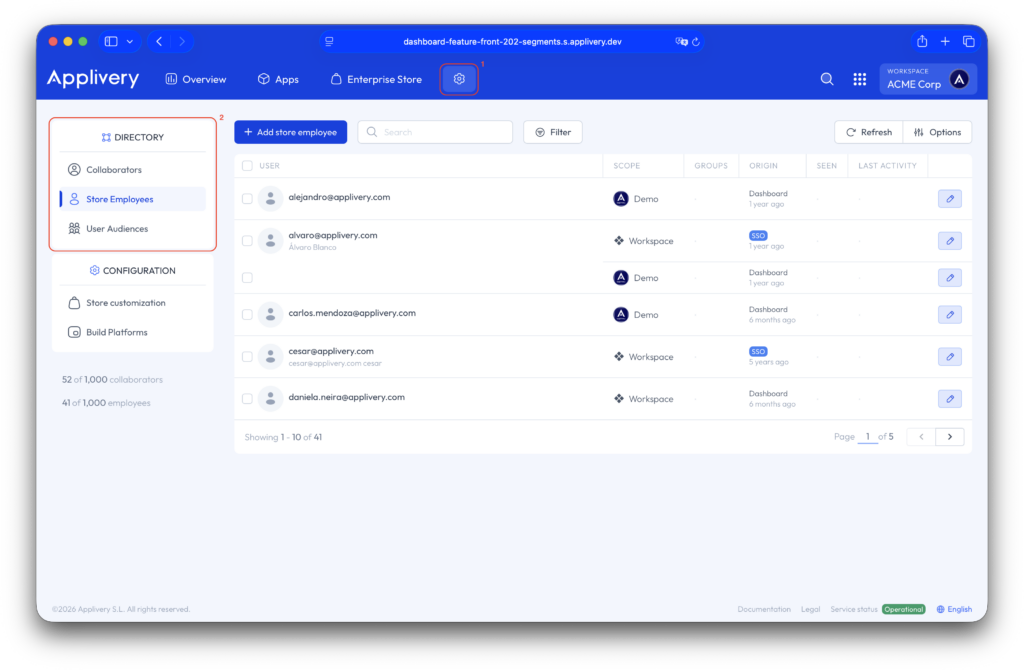
Once in the Applivery Dashboard, navigate to Settings (1) and, in the left-hand menu under the Directory (2) section, select the type of user you want to add.
Invitation flow #
When you invite someone to join your Workspace or Apps—whether as a Collaborator or a Store employee—they will receive an email. The invitation process differs slightly depending on the user type.
Collaborators #
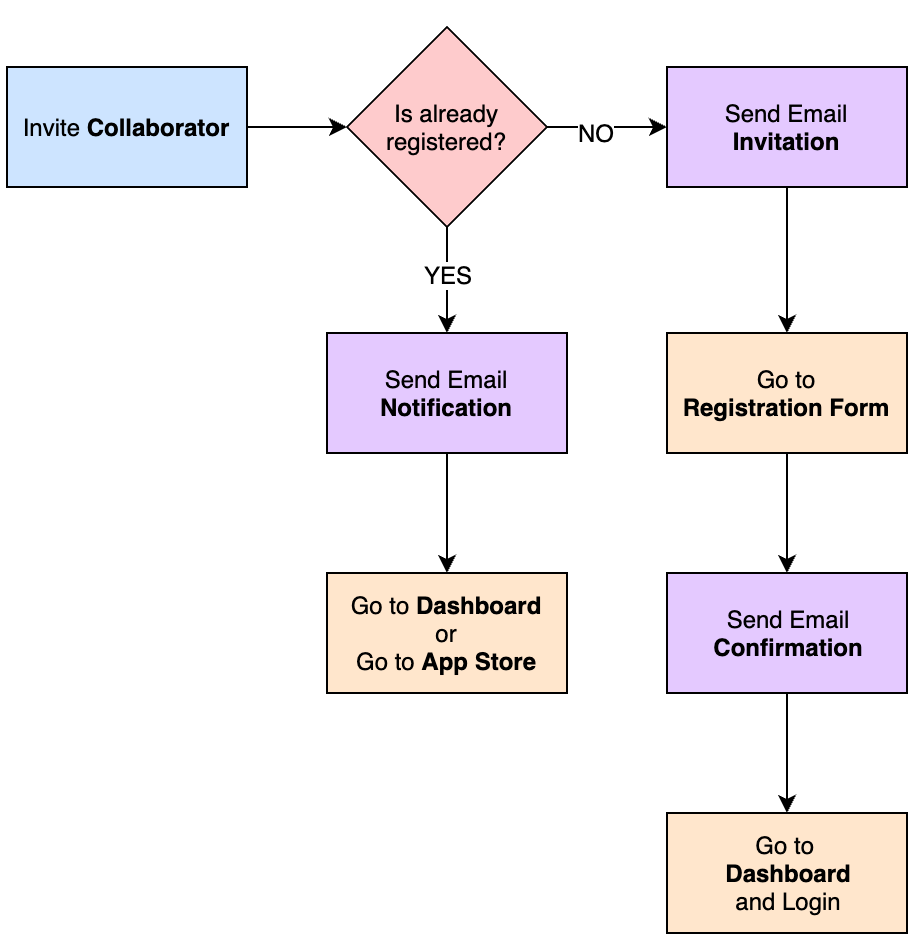
When inviting new collaborators to your project (Apps), two scenarios can occur:
New user
- The user receives an email invitation to sign up for Applivery. Their email address is pre-filled in the registration form.
- After registering, the user receives a second email to verify their email address.
- Once verified, the user is redirected to the login page to enter the credentials they just created.
- Finally, they access the Dashboard to start collaborating. They may need to select your Workspace from the left-hand menu to locate the App they were invited to.
Existing user
The user receives an email notification with a direct link to the Dashboard. They may need to log in first before accessing the App.
Store employees #
New employees are guided directly to your Enterprise Store. They follow a streamlined flow to access the Apps they are authorized to use.